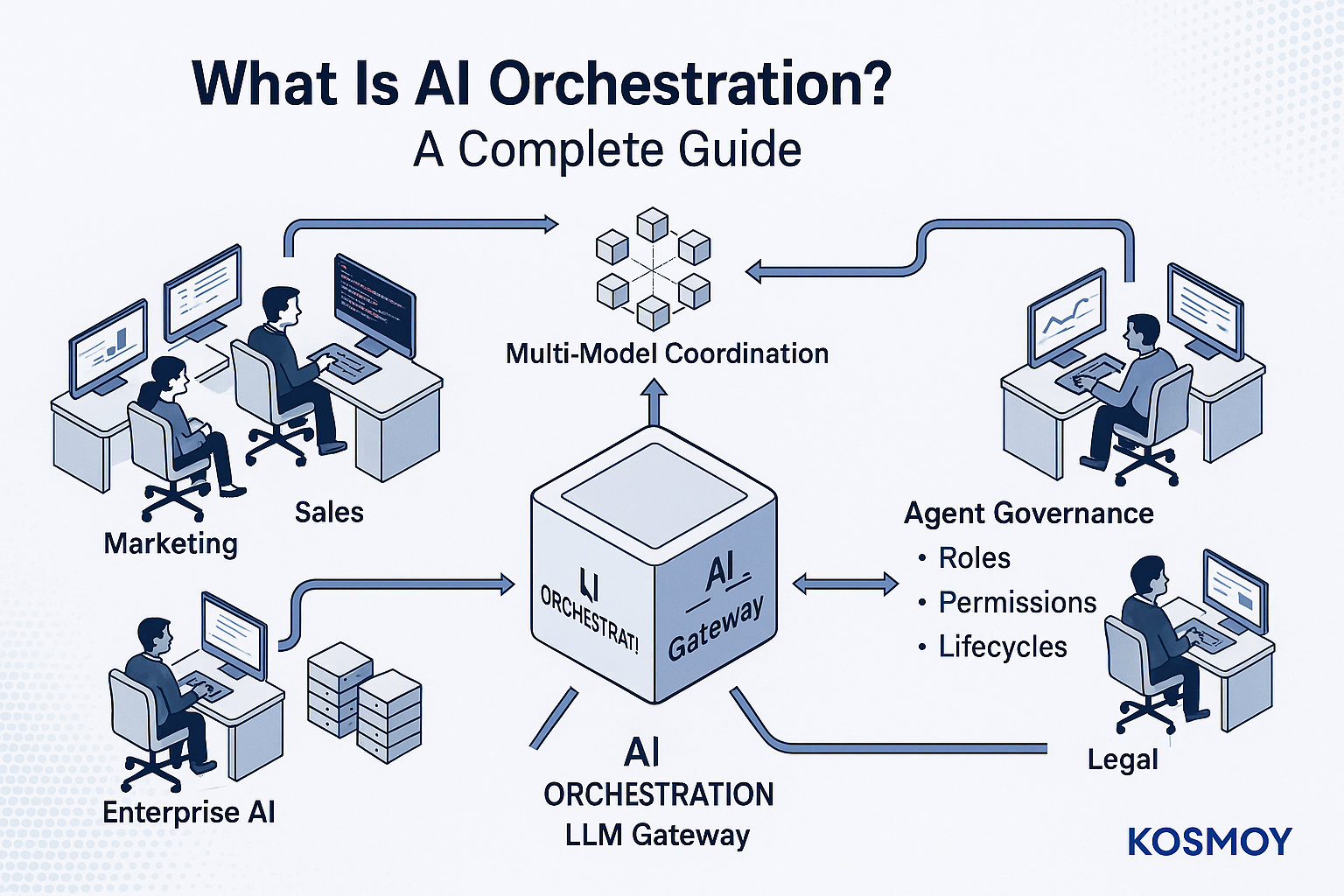

Deploying a single AI model is a solved problem. Deploying ten AI models, five autonomous agents, three retrieval systems, and a governance layer — simultaneously, across multiple departments, under regulatory scrutiny — is not. That is the problem AI orchestration exists to solve.
As enterprise AI programs mature from isolated pilots to production-scale deployments, the coordination challenge becomes the bottleneck. Individual models perform well in isolation. The difficulty is making them work together reliably, safely, and at the speed the business expects. AI orchestration is the architectural layer that makes that possible.
This guide explains what AI orchestration is, how it works, how it differs from related concepts, and what enterprises should look for when evaluating an orchestration platform.
What Is AI Orchestration?
AI orchestration is the coordination of multiple AI models, agents, tools, and data sources into a single integrated system — managing routing, context, permissions, policy enforcement, and observability across every interaction.
The operative word is coordination. A single LLM call is an inference. A chain of LLM calls that retrieves data, routes to specialized models, enforces compliance rules, and logs everything for audit is orchestration. The distinction matters because the engineering challenges are fundamentally different. Inference is a latency and quality problem. Orchestration is a systems problem: reliability, governance, cost attribution, and the organizational complexity of keeping dozens of moving parts working coherently over time.
In a mature enterprise AI deployment, orchestration handles:
- Routing — which model or agent receives which request, based on cost, capability, latency, or compliance requirements
- Context management — passing relevant state between components without exceeding context windows or leaking sensitive data between sessions
- Policy enforcement — applying guardrails, content filters, and access controls uniformly, regardless of which team built the application
- Data retrieval — fetching the right information from the right source (vector databases, APIs, internal knowledge bases) at the right moment in a workflow
- Observability — logging every action with structured metadata so the system is auditable, debuggable, and continuously improvable
No individual model, agent, or tool does all of this. The orchestration layer does.
How AI Orchestration Works: The Five Stages
Every AI orchestration workflow — regardless of complexity — passes through the same five operational stages.
1. Trigger
A workflow begins when an event occurs: a user submits a request, a scheduled job fires, an external system emits an alert, or an upstream agent completes a task. The orchestration layer receives the trigger and initiates the workflow.
2. Planning
The orchestration layer determines how to fulfill the request: which models to involve, which tools to call, which data sources to query, and in what order. For simple requests, this is a static routing decision. For agentic workflows, planning may itself involve an LLM that decomposes the goal into subtasks and allocates them to specialized agents.
3. Execution
Components execute — sequentially, in parallel, or through conditional branching based on intermediate results. The orchestration layer manages dependencies, handles errors and retries, and ensures that outputs from one component are correctly formatted as inputs for the next.
4. Governance
At every step, the orchestration layer enforces the rules that the organization has defined: access controls (can this agent reach this data source?), content policies (does this output satisfy guardrail requirements?), compliance rules (does this interaction satisfy EU AI Act or DORA obligations?), and cost limits (has this workflow exceeded its token budget?). Governance that lives inside individual applications is fragile and inconsistent. Governance enforced at the orchestration layer is uniform.
5. Observability
Every action, every model call, every tool invocation, and every policy decision is logged with structured metadata — timestamps, model versions, input/output hashes, latency, token consumption, and policy outcomes. This log is the foundation for compliance auditing, cost attribution, performance monitoring, and incident investigation.
AI Orchestration vs. Related Concepts
AI orchestration is frequently confused with adjacent terms. The distinctions matter for architectural decisions.
| Concept | What it does | What it doesn't do |
|---|---|---|
| AI orchestration | Coordinates the entire system — routing, context, governance, observability | It is not a single component; it is the layer that connects all components |
| Workflow automation | Executes specific task sequences (Zapier, n8n, RPA tools) | Does not manage LLM semantics, context windows, or agent autonomy |
| ML orchestration | Manages model development pipelines — training, evaluation, deployment (MLflow, Kubeflow) | Focuses on the model lifecycle, not production inference and agent governance |
| API gateway | Routes HTTP traffic, enforces rate limits and auth | Lacks LLM-specific semantics: no token tracking, no prompt policy, no agent context |
| Agent framework | Defines how a single agent reasons and acts (LangChain, AutoGen) | Governs one agent's behavior, not a multi-agent fleet or cross-department deployment |
The practical implication: a mature enterprise AI program needs all of these, but they are not substitutes for each other. An agent framework tells an individual agent what to do. The AI orchestration layer governs what the entire fleet of agents is allowed to do, can observe, and is accountable for.
The Core Components of an Enterprise AI Orchestration Layer
Centralized LLM Gateway
The AI Gateway is the single entry and exit point for all LLM traffic in the organization. Every model call — regardless of which application, department, or agent initiated it — passes through the gateway. This is where routing decisions are made, where policies are enforced, and where the audit log is built. Without a centralized gateway, governance is fragmented: each team implements its own controls, or none at all.
The gateway handles:
- Model routing — directing requests to the right provider (OpenAI, Anthropic, Azure, self-hosted) based on cost, capability, or compliance requirements
- Policy enforcement — applying content guardrails, PII screening, and regulatory rules to every request and response
- Cost attribution — tracking token consumption by team, application, and use case in real time
- Audit logging — recording every interaction with structured metadata for compliance and investigation
Agent Registry and Inventory
Before you can govern AI agents, you need to know what is running. An agent registry is a centralized inventory of every deployed agent: what it does, what systems it can access, which model it uses, who owns it, and what its risk classification is. Without a registry, the organization cannot answer the most basic governance question — "what AI agents are active right now, and what can they do?"
The registry also enables lifecycle management: versioning, deprecation, access review, and incident response at the fleet level rather than agent by agent.
Agent Sandboxing and Containment
AI agents that interact with production systems require infrastructure-level containment — not application-level guardrails that depend on the agent cooperating with its own constraints. A sandboxed execution environment enforces what the agent can and cannot do at the kernel level: which systems it can reach, which APIs it can call, and what data it can access. If an agent is compromised by a prompt injection attack or behaves unexpectedly, the sandbox contains the blast radius.
Sandboxing is not optional for high-risk agents. It is the technical mechanism that makes autonomous AI operationally viable in regulated environments.
No-Code Agent Builder
Business units build GenAI workflows faster than IT can approve them. A governed no-code agent builder — integrated with the same gateway and registry as everything else — channels that demand into the governed infrastructure rather than into shadow AI. Business users get the speed they need; the organization retains the visibility and control that governance requires.
Observability and Mission Control
Real-time dashboards that surface cost, usage, quality, and anomaly signals across the entire AI fleet. Not as a post-hoc reporting tool, but as the operational nerve center: operators can see what every agent is doing, intervene when something goes wrong, and continuously improve performance based on actual usage data.
AI Orchestration for Generative AI: What Changes with LLMs
Traditional software orchestration — microservices, API choreography, workflow engines — was designed for deterministic systems. GenAI introduces non-determinism, statefulness, and new failure modes that require orchestration capabilities that traditional tools weren't built for.
Prompt Versioning and Drift Management
Prompts are not static configuration. They evolve, degrade with model updates, and produce subtly different outputs over time. Enterprise AI orchestration needs to track prompt versions, detect output drift, and surface regressions before they affect business outcomes.
Context Window Management
LLMs have bounded context windows. In multi-step workflows, the orchestration layer must decide what to pass forward, what to summarize, and what to retrieve on demand — balancing completeness against token cost and latency. This is not a problem that application developers should solve individually; it belongs in the orchestration layer.
Token Cost Tracking and Attribution
Every LLM call has a cost. In a multi-agent, multi-department deployment, token consumption compounds quickly and unevenly. Orchestration-level cost attribution — tracking spend by team, application, and use case in real time — is the prerequisite for cost optimization and financial accountability.
Guardrails at the Inference Layer
Content policies that live inside individual applications are inconsistent and easy to bypass. Guardrails enforced at the orchestration layer — applied to every model call, regardless of source — are uniform and auditable. This is the architecture that satisfies both security requirements and regulatory expectations.
Agent Autonomy Governance
Autonomous agents introduce a new governance dimension that simple LLM orchestration doesn't address: an agent can take actions that persist beyond the conversation, affect external systems, and cascade in ways that are difficult to reverse. Orchestration for agentic AI must include kill switches, action logging, scope enforcement, and human-in-the-loop escalation paths — not just routing and policy enforcement.
AI Orchestration in Practice: Enterprise Use Cases
Financial Services — Fraud Detection with Compliance Routing
A fraud detection workflow might involve a retrieval model that fetches transaction history, a classification model that scores fraud probability, a rule engine that applies regulatory thresholds, and an escalation agent that routes high-confidence cases for human review. The orchestration layer manages the handoffs, enforces data residency requirements, logs every decision for regulatory audit, and ensures that no step in the chain bypasses compliance controls.
Customer Operations — Intent Classification to Resolution
A customer service orchestration workflow receives an inbound query, classifies intent, retrieves relevant knowledge base content, generates a response using the most cost-effective model for that query type, screens the output for compliance, and routes to a human agent if confidence is below threshold. Every step is auditable; cost is attributed to the relevant business unit; guardrails apply uniformly regardless of which department configured the workflow.
IT Operations — Anomaly Detection to Root-Cause Analysis
An IT operations agent monitors infrastructure metrics, detects anomalies, retrieves relevant runbooks and incident history, generates a root-cause hypothesis, and either resolves automatically (within its authorized scope) or escalates with a structured recommendation. The orchestration layer enforces what the agent can access, contains its blast radius, and logs every action for post-incident review.
Software Development — Issue to Deployment
A development orchestration workflow decomposes a bug report into subtasks, allocates them to specialized coding agents, runs automated tests, reviews outputs against quality gates, and triggers deployment when all checks pass. The orchestration layer manages parallelism, handles failures and retries, enforces code quality policies, and provides a complete audit trail of what each agent did at each step.
What to Look for in an Enterprise AI Orchestration Platform
Not all AI orchestration platforms are built for enterprise requirements. The capabilities that matter in a prototype are different from the capabilities that matter in a regulated production deployment.
Centralized governance, not per-application controls. Governance implemented inside individual applications is fragile. Look for a platform where policy enforcement, cost tracking, and audit logging are centralized infrastructure — applied uniformly, not delegated to each development team.
Multi-model, multi-provider routing. Vendor lock-in is a strategic risk. The orchestration layer should route traffic across providers based on capability, cost, and compliance requirements — and be able to switch providers without rewriting applications.
Agent containment, not just guardrails. Guardrails are application-layer controls. For agents with production system access, infrastructure-level sandboxing — kernel-enforced isolation and network-level egress control — is the only adequate containment mechanism.
Real-time observability, not retrospective reporting. Cost overruns, quality regressions, and security incidents surface in real time. The orchestration platform needs to surface signals while they are still actionable, not 24 hours later in a batch report.
Business-user access with enterprise-grade governance. The platform that requires a PhD to build workflows will drive business units to shadow AI. Look for a governed no-code builder that channels business-led innovation into the same infrastructure as everything else.
Regulatory compliance as infrastructure. EU AI Act, DORA, GDPR, and sector-specific frameworks are not optional. The orchestration layer should implement compliance as a structural feature — audit logging, data residency enforcement, risk classification — not as a checklist of documentation to produce after the fact.
Where this stands in August 2026
Two shifts since this guide was first published make the orchestration argument stronger, and one regulatory date moved.
The first shift is protocol traffic. Agents increasingly act through MCP tool calls and agent-to-agent (A2A) messages rather than plain LLM completions. An orchestration layer that only sees model calls misses a growing share of what agents actually do, so MCP and A2A traffic have become first-class orchestration concerns: routed, governed and logged like any model call.
The second is consolidation. Palo Alto Networks completed its acquisition of Portkey, the best-known standalone gateway, in May 2026 and folded it into its security platform. Point tools are being absorbed into platforms, which changes how buyers evaluate the orchestration layer: platform scope, vendor independence and deployment control now matter as much as feature lists. Our guide to the best AI management platforms in 2026 tracks that consolidation in detail.
On regulation, the EU AI Act timeline shifted under the Digital Omnibus agreement of May 2026. High-risk obligations now phase in from December 2027 and August 2028, while Article 50 transparency obligations kept their August 2026 date. That is more runway, not a reprieve. The audit logging, risk classification and registries described in this guide are exactly the evidence those deadlines will require, and evidence cannot be reconstructed retroactively.
How Kosmoy Approaches AI Orchestration
Kosmoy is built around the principle that AI orchestration is an infrastructure problem, not an application problem. The controls that matter — governance, cost visibility, agent containment, compliance — need to live in the platform, not inside each team's implementation.
The Kosmoy platform provides a complete AI orchestration layer for enterprise deployments:
Kosmoy AI Gateway is the centralized control point for all LLM traffic. Every model call routes through the gateway, where routing decisions are made, policies are enforced, costs are attributed, and every interaction is logged. Teams build applications against any model or provider; the gateway ensures every call is governed.
Kosmoy Action Capsule provides Kubernetes-native sandboxing for autonomous AI agents. Each agent runs in an isolated execution environment with containment enforced at the Linux kernel level. All outbound calls route through the AI Gateway — the only authorized exit point. Agents retain their full capability; their blast radius is bounded by the Capsule.
Kosmoy Mission Control is the operational dashboard for the entire AI fleet: real-time visibility into cost, usage, quality, and agent behavior across every department and application. Operators can monitor, intervene, and audit without needing to instrument individual applications.
Kosmoy Studio is the governed no-code agent builder that lets business users compose and deploy GenAI workflows — on the same infrastructure, under the same policies, with the same audit logging — as everything built by engineering.
Together, these components form an orchestration layer that separates governance from implementation: teams build what they need to build; the platform ensures every deployment is safe, observable, and compliant.
Frequently asked questions
What is AI orchestration?
AI orchestration is the coordination of multiple AI models, agents, tools and data sources into a single integrated system. It manages routing, context, policy enforcement and observability across every component, which is what makes complex, multi-step AI workflows reliable, auditable and scalable in production.
How is AI orchestration different from workflow automation?
Workflow automation tools such as Zapier, n8n or RPA platforms execute fixed task sequences. AI orchestration is broader: it manages LLM semantics, context window state, agent autonomy, governance enforcement and compliance logging across the whole AI estate. Automation runs a workflow; orchestration governs every model, agent and workflow together.
What is the difference between an AI orchestration platform and an agent framework?
An agent framework (like LangChain or AutoGen) defines how a single agent reasons, plans, and acts. An AI orchestration platform governs a fleet of agents: routing, policy enforcement, containment, cost attribution, and audit logging across every agent, every application, and every department. One governs an individual agent's behavior; the other governs the entire system.
Why do enterprises need AI orchestration?
Because coordination problems scale faster than AI capability. Once an organization runs multiple models and agents across departments, per-team controls diverge, costs accumulate without visibility and audit trails stay incomplete. An orchestration layer applies routing, governance and logging uniformly, which is what makes enterprise-scale AI manageable.
What is an LLM gateway and how does it relate to AI orchestration?
An LLM gateway is the centralized layer through which all model calls pass — handling routing, authentication, policy enforcement, cost tracking, and audit logging. It is the core infrastructure component of an AI orchestration platform. Without a gateway, governance is fragmented across individual applications. With it, every LLM interaction is governed uniformly, regardless of who built the application or which provider hosts the model.
What is agent sandboxing and why does it matter for AI orchestration?
Agent sandboxing is an infrastructure-level execution environment that constrains what an autonomous AI agent can do — which systems it can reach, which APIs it can call, what data it can access — enforced at the kernel and network level rather than at the application layer. Sandboxing matters because autonomous agents take actions that persist and propagate. Guardrails ask the agent to constrain itself; a sandbox enforces the constraint regardless of the agent's behavior.
How does AI orchestration support regulatory compliance?
AI orchestration platforms that implement compliance at the infrastructure level — structured audit logging, data residency enforcement, PII screening at the gateway, risk classification in the agent registry — provide the documentation and control evidence that EU AI Act, DORA, and GDPR require. Compliance implemented per-application is inconsistent and difficult to demonstrate at audit. Compliance built into the orchestration layer is uniform and auditable by design.
What is the difference between AI orchestration and MLOps?
MLOps manages the model development lifecycle: data pipelines, training, evaluation and deployment. AI orchestration manages production inference: routing, governance, agent behavior, cost attribution and compliance across deployed models and agents. Both are necessary, and they answer different questions at different phases of the AI lifecycle.