Kosmoy vs OneTrust AI Governance: Compared for 2026
OneTrust AI Governance extends the biggest privacy/GRC suite in the market into AI: inventory, assessments, EU AI Act automation, agent detection. Kosmoy enforces policy in the production request path — the place OneTrust's own AI Guard documentation stops short of. For many enterprises the real question is not either/or but where each layer ends.
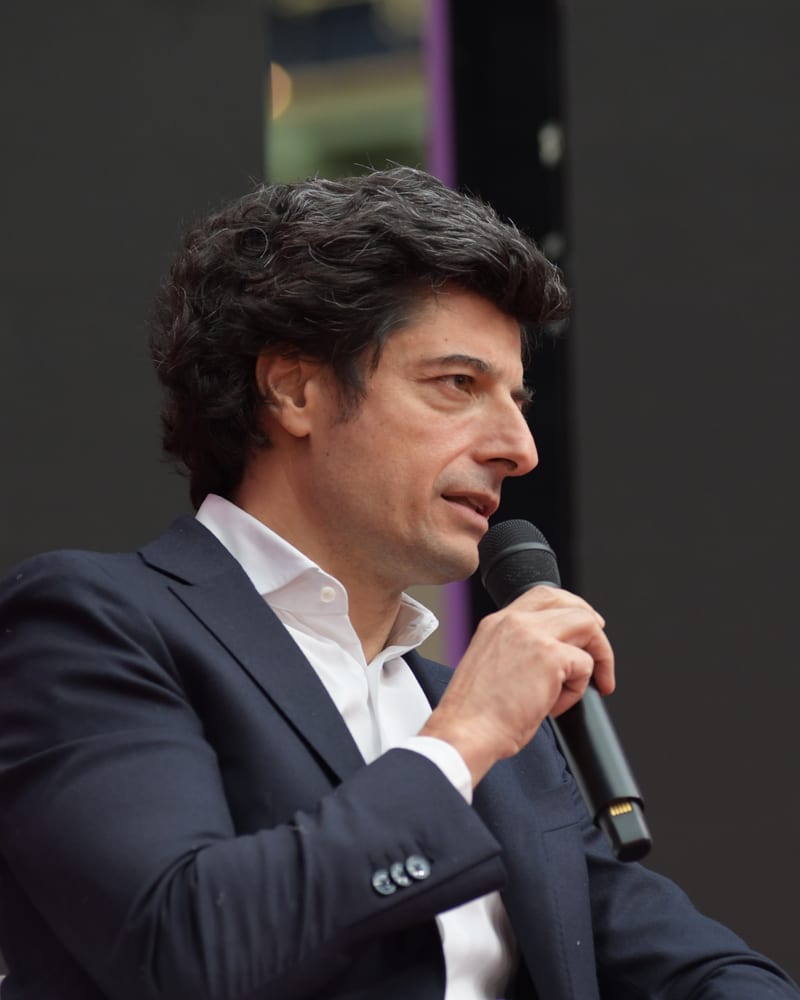 Umberto MalesciCEO & Co-Founder, Kosmoy
OneTrust reaches AI governance from the strongest possible starting position: roughly 14,000 organizations already run its privacy and GRC platform, with a reported ~$500M in ARR (company profile). Its AI Governance module attaches to that installed base — a central AI inventory, impact assessments that reuse the DPIA muscle privacy teams already have, EU AI Act and ISO 42001 automation with automatic risk re-classification, and, since the Spring '26 release, generally available Agent Detection across AWS Bedrock, Azure AI Foundry and Google Vertex AI. Gartner placed OneTrust as a Visionary in the inaugural Magic Quadrant for AI Governance Platforms (June 16, 2026).
OneTrust is also honest about where its runtime story currently ends, and this page takes it at its word. AI Guard — a Python SDK and REST API that classifies prompts and responses with 300+ classifiers and can mask or block sensitive data — is described in OneTrust's own documentation as optimized for development and testing workloads and “not recommended for large classification volumes generally seen in externally facing AI applications or agents”. Kosmoy is built for precisely that production traffic: a self-hosted gateway on every call, guardrails, budgets and agent containment. The comparison below is really a map of where the program layer ends and the enforcement layer begins.
Who each product is for
OneTrust AI Governance
OneTrust AI Governance speaks to privacy, compliance and GRC leaders — CPOs, DPOs, AI governance committees — most often at organizations already invested in the OneTrust suite. AI systems and models are registered in a central inventory, assessed through workflows that extend familiar DPIA/PIA patterns, and mapped to the EU AI Act, ISO 42001 and NIST AI RMF with automated control mapping and automatic risk re-classification when models, data or agents change (EU AI Act solution).
The 2026 releases pushed toward operations: Agent Detection across Bedrock, Azure AI Foundry and Vertex AI reached GA, AI Guardrail Enforcement entered Public Preview, and a March 2026 announcement framed the whole direction as a 'continuous control plane' for AI. The runtime piece that exists today, AI Guard, embeds as a per-application SDK and is scoped by OneTrust to development and testing workloads (AI Guard docs).
Kosmoy
Kosmoy speaks to the teams accountable for AI in production: CTOs, CISOs and platform engineering in banks, insurers and defence. Every AI system sits in four registries with an owner and a risk tier — including a master agent registry fed by connectors from Azure AI Foundry, Bedrock, Vertex, Salesforce and ServiceNow. Every call crosses one policy-enforcing gateway; every autonomous agent runs inside an Action Capsule sandbox with per-task credentials and a kill switch.
It is single-tenant software in your own Kubernetes, air-gap capable — Italy's central bank and banking regulator and Europe's largest defence and aerospace group run it in production — and EU AI Act, ISO 42001 (aligned) and NIST AI RMF evidence bundles are generated from registry state plus gateway logs.
The capability radar
Each spoke is one capability, scored 0–10. The products tie at 9 on Compliance & Audit — OneTrust's nine is program automation at suite scale (assessments, control mapping, automatic re-classification, privacy adjacency), Kosmoy's is enforcement-derived evidence. OneTrust's 8 on AI Inventory & Discovery sits just under Kosmoy's 9: both take the connector approach to agent discovery, OneTrust across three cloud AI platforms, Kosmoy across five sources including Salesforce and ServiceNow. From there the chart tilts: gateway (8 vs 3), guardrails (8 vs 5), containment (9 vs 1), observability (7 vs 2) and sovereignty (10 vs 2) all run to Kosmoy — the runtime half of the problem, which OneTrust's own docs largely defer.
- OneTrust AI Governance
- Kosmoy
| Capability (0–10) | OneTrust AI Governance | Kosmoy | Notes on OneTrust AI Governance |
|---|---|---|---|
| AI Inventory & Discovery | 8 | 9 | Central AI registry with Agent Detection across Bedrock, Azure AI Foundry and Vertex AI (GA Spring '26). |
| Security & Shadow AI | 6 | 8 | Agent detection across cloud AI platforms; oversight is workflow-driven rather than network-level. |
| Observability & FinOps | 2 | 7 | AI Guard streams classification metrics into AI Governance; no cost or token telemetry documented. |
| Gateway & Policy Control | 3 | 8 | AI Guard is a per-app SDK in the inference path, scoped by OneTrust to dev/test — not a central gateway. |
| Guardrails & Runtime Safety | 5 | 8 | 300+ classifiers mask or block PII, secrets and proprietary code; prompt-injection and toxicity filtering not documented. |
| Agent Containment | 1 | 9 | Agent oversight is detection and monitoring; no sandbox, scoped credentials or kill switch documented. |
| Compliance & Audit | 9 | 9 | EU AI Act, ISO 42001 and NIST AI RMF automation with automatic risk re-classification on change. |
| Testing, Evals & Red-teaming | 2 | 7 | Questionnaire-driven assessments; AI Guard is marketed for narrow pre-production PII-risk testing. |
| Agent Building | 1 | 6 | OneTrust's own AI agents automate work inside its platform; no customer-facing builder. |
| Deployment Sovereignty | 2 | 10 | Multi-tenant SaaS; no self-hosted or air-gapped deployment documented. |
Bold marks the highest score on each row. 10 is reserved for categorical architectural facts; specialists are expected to outscore platforms on their own spoke.
From policy to enforcement
Put one governance control plane around enterprise AI.
Inventory models, agents and applications, assign ownership and risk, enforce policy on live traffic and keep the audit record current.
Where OneTrust AI Governance wins
Program integration at suite scale. AI governance attaches to the privacy program ~14,000 organizations already run: DPIA/PIA workflows extend to AI impact assessments, third-party risk extends to AI vendors, and the Data Discovery classification engine powers AI Guard's 300+ classifiers. No standalone governance product — Kosmoy included — can match the switching cost already paid.
Compliance automation depth. EU AI Act, ISO 42001 and NIST AI RMF templates with automated control mapping, regulatory updates, conformity-assessment guidance and automatic risk re-classification when models, data or agents change (EU AI Act solution) — recognized with a Visionary position in the inaugural Gartner Magic Quadrant for AI Governance Platforms, June 16, 2026 (MQ summary).
Agent discovery, generally available. Agent Detection across AWS Bedrock, Azure AI Foundry and Google Vertex AI reached GA in the Spring '26 release, feeding a searchable org-wide agent inventory (release blog). Among GRC-heritage vendors, that is a concrete, shipped answer to the shadow-agent problem.
Data-classification pedigree. AI Guard's classifiers come from OneTrust Data Discovery — years of production PII, secrets and proprietary-code detection — and the SDK itself is open source under Apache-2.0 (GitHub). For pre-production PII-risk testing of AI apps, it is a credible, well-documented tool.
Where Kosmoy wins
Production-scale runtime enforcement. OneTrust's own AI Guard documentation scopes it to development and testing workloads and advises against the classification volumes of externally facing AI applications or agents. Kosmoy's gateway exists for exactly those volumes: guardrails, RBAC, budgets and logging enforced in-line on every LLM, MCP and agent-to-agent call in production.
A gateway, not a per-app SDK. AI Guard must be embedded in each application's code. Kosmoy is a central policy point — applications move onto it by changing a base URL, and policy, access control and cost limits apply uniformly across every app and agent without per-team integration work.
Containment. OneTrust's agent story is detection, inventory and monitoring; no sandboxing, scoped credentials or kill switch are documented as of July 15, 2026. Kosmoy's Action Capsule runs each agent in a kernel-enforced sandbox whose only egress is its paired gateway, with per-task credentials and a kill switch — containment as architecture.
Observability and FinOps. OneTrust streams AI Guard classification metrics into its governance module; token spend, cost attribution, budgets and traces are not documented. Kosmoy tracks cost, usage and agent traces per model, app and user, with budgets enforced at the gateway.
Sovereignty. OneTrust is multi-tenant SaaS with no self-hosted or air-gapped option documented. Kosmoy is single-tenant software in your own Kubernetes, air-gap included — prompts and evidence never transit a vendor cloud.
Deployment and pricing model
| OneTrust AI Governance | Kosmoy | |
|---|---|---|
| Hosting model | Multi-tenant SaaS | Self-hosted only — single-tenant, your own Kubernetes (air-gap capable) |
| Runtime data path | AI Guard SDK per app — scoped by OneTrust to dev/test workloads | In-line gateway on every LLM, MCP and A2A call in production |
| Agent oversight | Agent Detection GA (Bedrock, Azure AI Foundry, Vertex AI); monitoring only | Master agent registry (five connector sources) plus Action Capsule sandbox and kill switch |
| Open source | Platform proprietary; AI Guard SDK Apache-2.0 | Proprietary |
| Pricing model | Enterprise quote; AI Governance pricing not published | Enterprise subscription; no self-service tier |
| Ownership | Private, VC-backed (~$1.1B raised; founded 2016) | Independent, founder-owned |
Last verified July 15, 2026 against each vendor's public documentation.
Running them together
For a OneTrust shop, the practical architecture is layered rather than either/or. OneTrust remains the program of record — assessments, policy library, vendor risk, EU AI Act documentation — while Kosmoy becomes the enforcement point for production traffic: gateway policy, guardrails, budgets, agent containment. The two inventories reconcile naturally: both discover agents through platform connectors (OneTrust across Bedrock, Foundry and Vertex; Kosmoy across those plus Salesforce and ServiceNow), and Kosmoy's registry state and enforcement logs are exportable evidence for the controls OneTrust tracks.
OneTrust's March 2026 'continuous control plane' announcement signals it intends to grow into runtime governance — AI Guardrail Enforcement is in Public Preview now. Until that matures beyond preview and beyond AI Guard's documented dev/test scope, the pragmatic read is the one its own docs support: run the program in OneTrust, enforce in the request path with something built for it.
Questions buyers ask
Is OneTrust AI Governance better than Kosmoy?
For the governance program — inventory workflows, impact assessments, EU AI Act automation, vendor risk — yes, especially if you already run OneTrust for privacy: the AI module reuses assessments, classifiers and processes your compliance team knows, and Gartner rates OneTrust a Visionary in the 2026 MQ for AI Governance Platforms. For runtime enforcement — gateway policy, production guardrails, FinOps, agent containment, sovereign deployment — Kosmoy is the stronger product, and OneTrust's own AI Guard documentation draws that boundary itself.
Can OneTrust AI Guard protect production AI applications?
OneTrust's documentation says AI Guard is optimized for development and testing workloads and is 'not recommended for large classification volumes generally seen in externally facing AI applications or agents' as of July 15, 2026. It is a genuine runtime data-protection layer — 300+ classifiers that can mask or block PII, secrets and proprietary code — but per OneTrust's own scoping, it is a pre-production tool. Production-path enforcement is where a gateway platform like Kosmoy fits.
We already use OneTrust for privacy — do we still need Kosmoy?
It depends on which problem is open. If the gap is program-shaped — no AI inventory, no assessments, no EU AI Act evidence — the OneTrust AI Governance module may be all you need. If the gap is runtime-shaped — nothing enforcing policy on live LLM and agent traffic, no cost controls, no containment for autonomous agents, or a sovereignty requirement SaaS cannot meet — that is the layer Kosmoy adds, and the two work better stacked than either does stretched.
Can OneTrust help with EU AI Act compliance?
Yes — it is one of its strongest areas: assessment templates, automated control mapping to the EU AI Act, ISO 42001 and NIST AI RMF, conformity-assessment guidance and automatic risk re-classification when systems change. Plan against the current timeline: under the May 2026 Digital Omnibus agreement, high-risk obligations land in December 2027 and August 2028, while Article 50 transparency obligations still apply from August 2, 2026. Kosmoy complements the documentation side with runtime enforcement evidence from its gateway and registries.
What does OneTrust AI Governance cost?
OneTrust does not publish AI Governance pricing; it sells by enterprise quote through its [pricing page](https://www.onetrust.com/pricing/). Third-party estimates circulate but are not confirmed by the vendor. Kosmoy is likewise an enterprise subscription without a self-service tier — for both products, budget for a sales process rather than a checkout.
Can I run OneTrust and Kosmoy together?
Yes, and for large OneTrust estates it is the sensible architecture: OneTrust as the program of record for assessments, policy and vendor risk; Kosmoy as the production enforcement point whose gateway logs, guardrail verdicts and containment events become evidence for the program. Their agent inventories can cross-check each other — two independent discovery paths make shadow agents harder to miss.
Sources
Every factual claim about another vendor on this page traces to that vendor's own published material or a named third-party source below.
- Kosmoy AI Governance — accessed July 15, 2026
- Kosmoy AI Gateway — accessed July 15, 2026
- OneTrust AI Guard documentation (dev/test scoping) — accessed July 15, 2026
- Gartner Magic Quadrant for AI Governance Platforms (June 16, 2026) — third-party summary — accessed July 15, 2026
- OneTrust AI Guard FAQ — accessed July 15, 2026
- AI Guard SDK (GitHub, Apache-2.0) — accessed July 15, 2026
- OneTrust expands AI Governance for real-time AI (press release, March 9, 2026) — accessed July 15, 2026
- OneTrust Spring '26 release notes (AI Guardrail Enforcement, Agent Detection GA) — accessed July 15, 2026
- OneTrust Winter '26 release blog (agent detection, AI inventory analysis) — accessed July 15, 2026
- OneTrust EU AI Act compliance solution — accessed July 15, 2026
- OneTrust company profile (customers, ARR) — accessed July 15, 2026
See the platform behind the scores
Kosmoy puts an inventory, a policy gateway and a containment sandbox around every AI your teams run — in your own Kubernetes.
Or email sales@kosmoy.com.