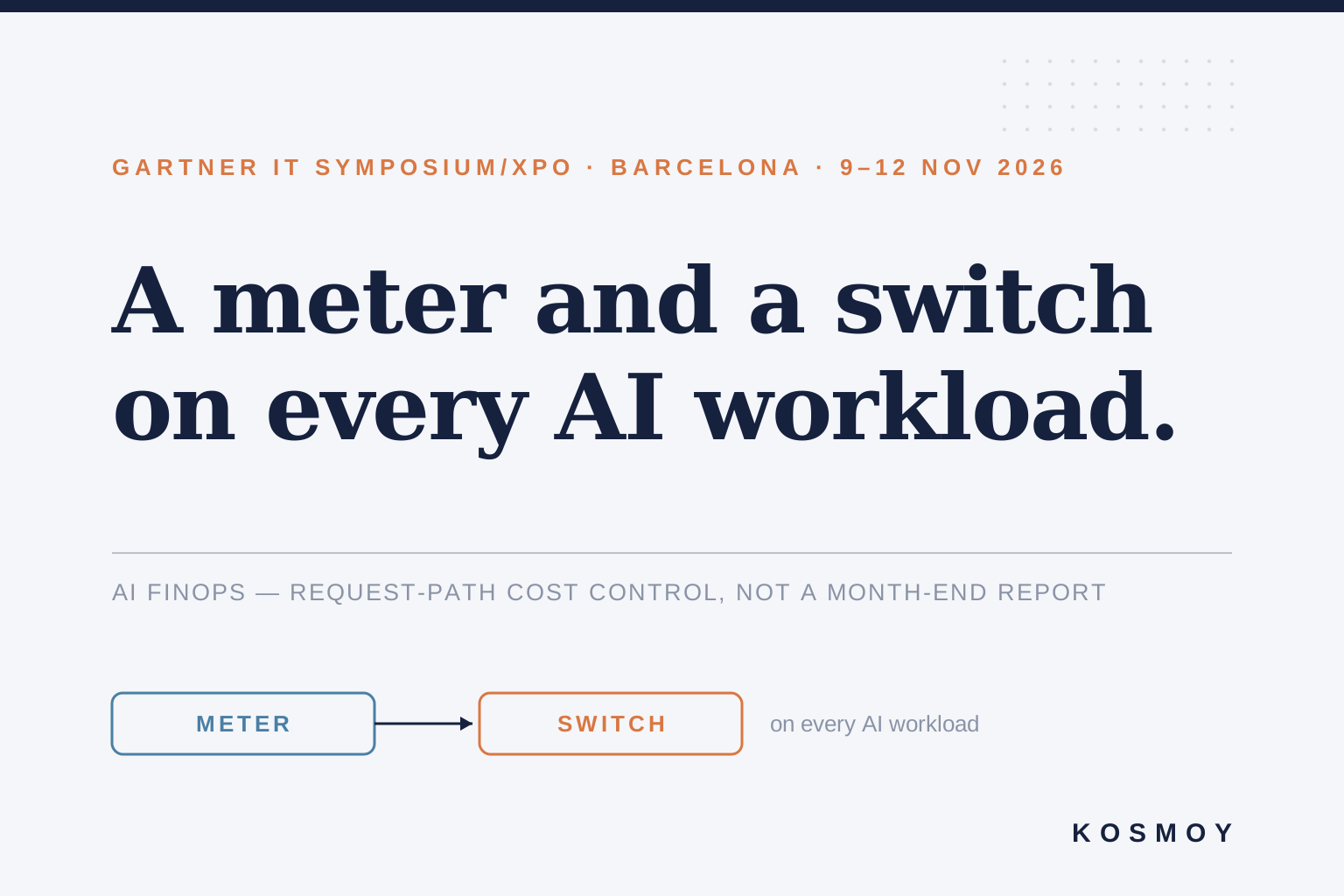

Somewhere in every CIO's Barcelona schedule is a session about AI value, and somewhere in every CFO's inbox is the reason the session is full: an AI bill nobody can fully explain. If that tension is on your agenda for Gartner IT Symposium/Xpo 2026, this is the architecture argument to bring — because the fix is not a better report. It is a meter and a switch on every AI workload.
Why the invoice keeps surprising you
Cloud FinOps grew up on a comfortable fact: spend was capacity you provisioned. You could read the bill, right-size the fleet, buy commitments, and the next month behaved. AI spend broke the assumption. It is consumption a model — or an agent — decides at runtime: tokens scale with every request, the choice between a small model and a frontier one moves unit cost by an order of magnitude, context growth compounds silently on every conversation turn, retries multiply invisibly, and an agent calling tools decides for itself how many steps a task takes. A planning loop that never converges spends until something stops it.
The provider invoice arrives after all of those decisions are spent, aggregated to one number per API key. Whoever gets that number owns an argument, not a control.
The meter and the switch
The architecture answer is old-fashioned utility thinking. Every AI call crosses one wire — a gateway — and on that wire sit two instruments:
The meter attributes every call as it happens: provider, model, application, team, user or service identity, agent, tool — including the failed and retried calls the invoice will silently merge. Attribution at the call is what makes ownership real: the overrun has a name, a use case and a diff that caused it.
The switch is what the meter alone can never be. Budgets warn owners as a limit approaches — and past the cap, the gateway refuses the call. A looping agent burns its allowance and stops, at machine speed, without waking anyone. Routing is the switch's constructive mode: work that fits a smaller model goes to one, and evaluations confirm the cheaper route holds quality before the saving becomes policy.
This is the whole content of the phrase request-path AI FinOps — and the full argument lives on our AI FinOps platform page.
Where invoice-side FinOps still wins
Nothing above retires your allocation platform. Invoice-side products — Finout, Vantage, CloudZero and peers — ingest the cloud, SaaS and AI bills the gateway never sees and turn them into unit economics finance can close the month on. They answer what did everything cost, allocated to whom; the request path answers what is this call costing, and may it proceed. The mature 2026 stack runs one of each, and the honest scoring of who does what is in our AI FinOps buyer's guide — eight platforms, both families, limits included.
Five questions for the Barcelona expo floor
- When a workload passes its budget, what happens to the next call? An alert means a meter. A refusal means a switch. There is no third answer worth a follow-up meeting.
- Where do failed and retried calls show up? The user saw one answer; the bill recorded three attempts. If the product reads invoices, it cannot know.
- Can attribution name the agent and the tool, not just the API key? Agent workloads are where 2026 budgets die; key-level attribution was built for a world without them.
- Who is authorized to raise a cap, and is that logged? A cap that any engineer can lift quietly is an alert with better marketing.
- Where does the cost data live? Request-path records embed prompts and identities. If that telemetry transits a vendor's cloud, your FinOps tooling just became a data-governance question.
Score the answers the way you would score any control: a yes without a mechanism is a no.
The part that is really governance
A budget is a policy about money. The moment it is enforced — not reported — it needs the same machinery as every other policy: an owner, an approval, an audit trail, and a place in the same evidence stream your regulators read. That is why AI FinOps done properly stops being a finance tool and becomes a governance layer. It is also why we will be demonstrating the meter and the switch in Barcelona as one workflow with the registry, the gateway and the kill switch — not as a dashboard.
Bring your worst AI bill. We will map, line by line, where a meter would have named it and where a switch would have stopped it. Book a Barcelona meeting, or email sales@kosmoy.com with the days you are on site. If you want homework first, the LLM cost calculator models what routing alone would save you — your prices, not ours.
FAQ
What should a CIO ask AI FinOps vendors at a conference?
One question sorts the whole category: when a workload passes its budget, what happens to the next call? If the answer is an alert, the product is a meter. If the answer is the call is refused, it is a meter and a switch. Both are useful; only one is control. Then ask where failed and retried calls appear — invoices aggregate them away.
Why is AI spend harder to control than cloud spend?
Cloud spend is capacity you provision; AI spend is consumption a model or agent decides at runtime. Tokens scale with every request, model choice moves unit cost by an order of magnitude, context growth compounds silently, retries multiply invisibly, and an agent in a tool loop has no natural stopping point. The invoice arrives after all of those decisions are spent.
Do enterprises need both invoice-side and request-path AI FinOps?
Usually, yes. Invoice-side platforms allocate the whole estate — cloud, SaaS and AI bills — into unit economics finance can close on. Request-path FinOps measures and controls each AI call while it happens: attribution, budgets, hard caps, routing. One reports the past; the other governs the present. Mature stacks run one of each.
Gartner and Gartner IT Symposium/Xpo are trademarks of Gartner, Inc. and/or its affiliates. Kosmoy is an exhibitor at the 2026 Barcelona conference. Gartner does not endorse Kosmoy or its products.