AI GOVERNANCE · LLM ROUTERS
Pick the right model for each prompt.
Agentic routing for cost optimisation. Algorithmic routing for fault tolerance and load balancing. One Gateway endpoint.
Or email sales@kosmoy.com.
The price gap between a frontier model and a small one is often two orders of magnitude. The LLM Router decides which one serves each prompt — without changing application code.
Quality is monitored through user feedback and performance metrics; if a cheaper route degrades, the Router reverts.
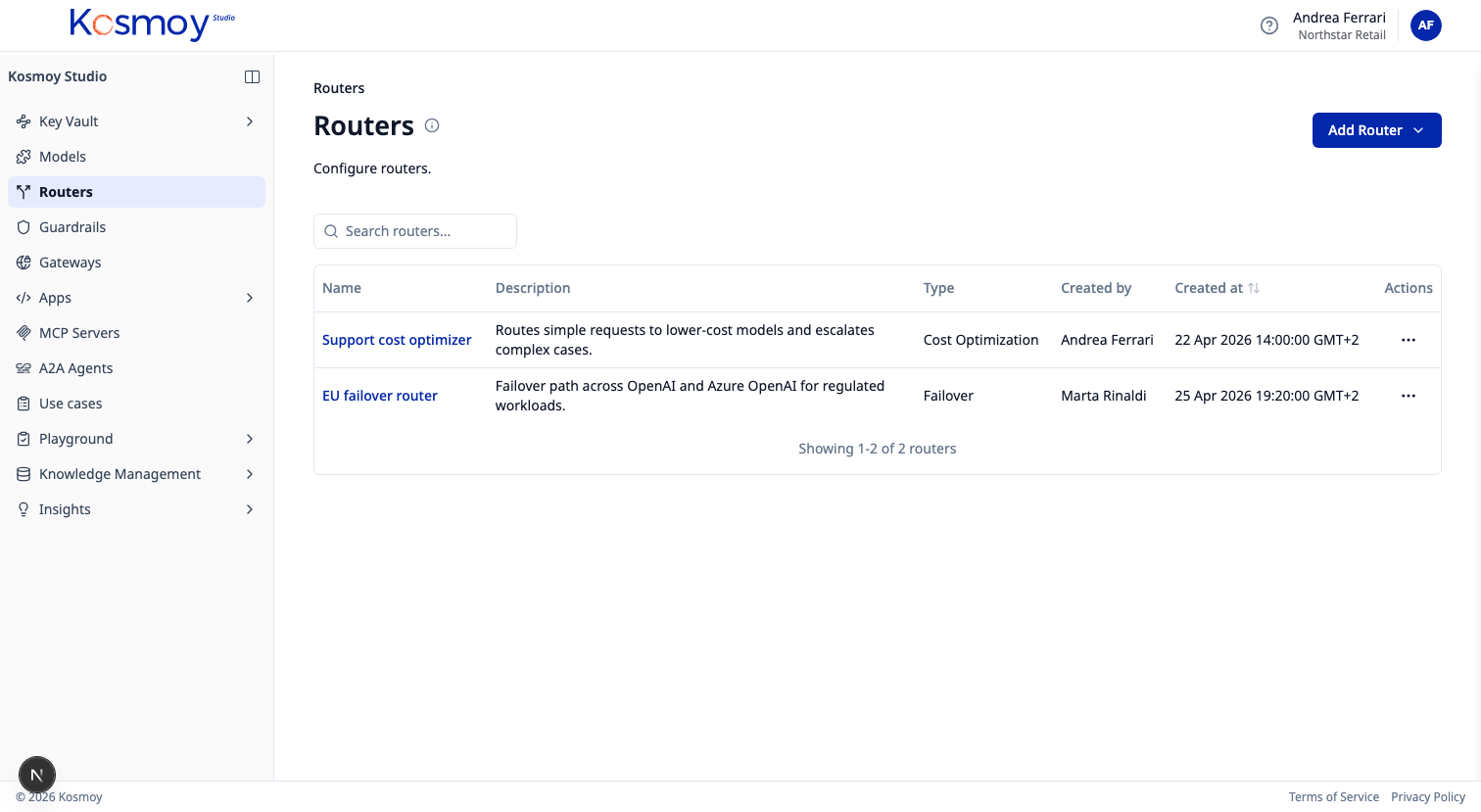
What it does.
Agentic router
Small fine-tuned judge model picks the cheapest model that fits the task.
Algorithmic router
Primary + fallback chains. Fault tolerance across providers.
Quality feedback loop
User feedback and performance metrics feed routing decisions.
Per-use-case rules
Some use cases pin to a specific model. The Router respects the constraint.
Observable
Every routing decision is an event. Audit and explain after the fact.
Zero app changes
Apps call the OpenAI-compatible Gateway endpoint. The Router is invisible.
Module questions, answered straight.
What's the difference between agentic and algorithmic routing?
Agentic routing: a small fine-tuned judge model reads the prompt and picks the cheapest model that fits the task. Algorithmic routing: rule-based fallback and load balancing across providers when the primary fails.
Does routing affect application code?
No. Apps call the Kosmoy Gateway (OpenAI-compatible API). The Router decides which model serves each prompt. The app sees one endpoint.
How is quality protected when cost is cut?
User feedback and performance metrics feed back into the routing decision. If cheaper-model quality drops, the Router reverts. The optimisation loop is observable.
Enterprise proof
Built for environments where AI cannot become another unmanaged SaaS silo.
Kosmoy works with regulated and operationally critical organizations, including Banca d’Italia and Leonardo.


- Runs in your Kubernetes
- Azure · AWS · GCP · on-prem
- LLM · MCP · A2A
- No mandatory vendor-hosted control plane
See agentic + algorithmic routing in action.
Walk through the cost-optimisation loop and fault tolerance across providers.
Or email sales@kosmoy.com.