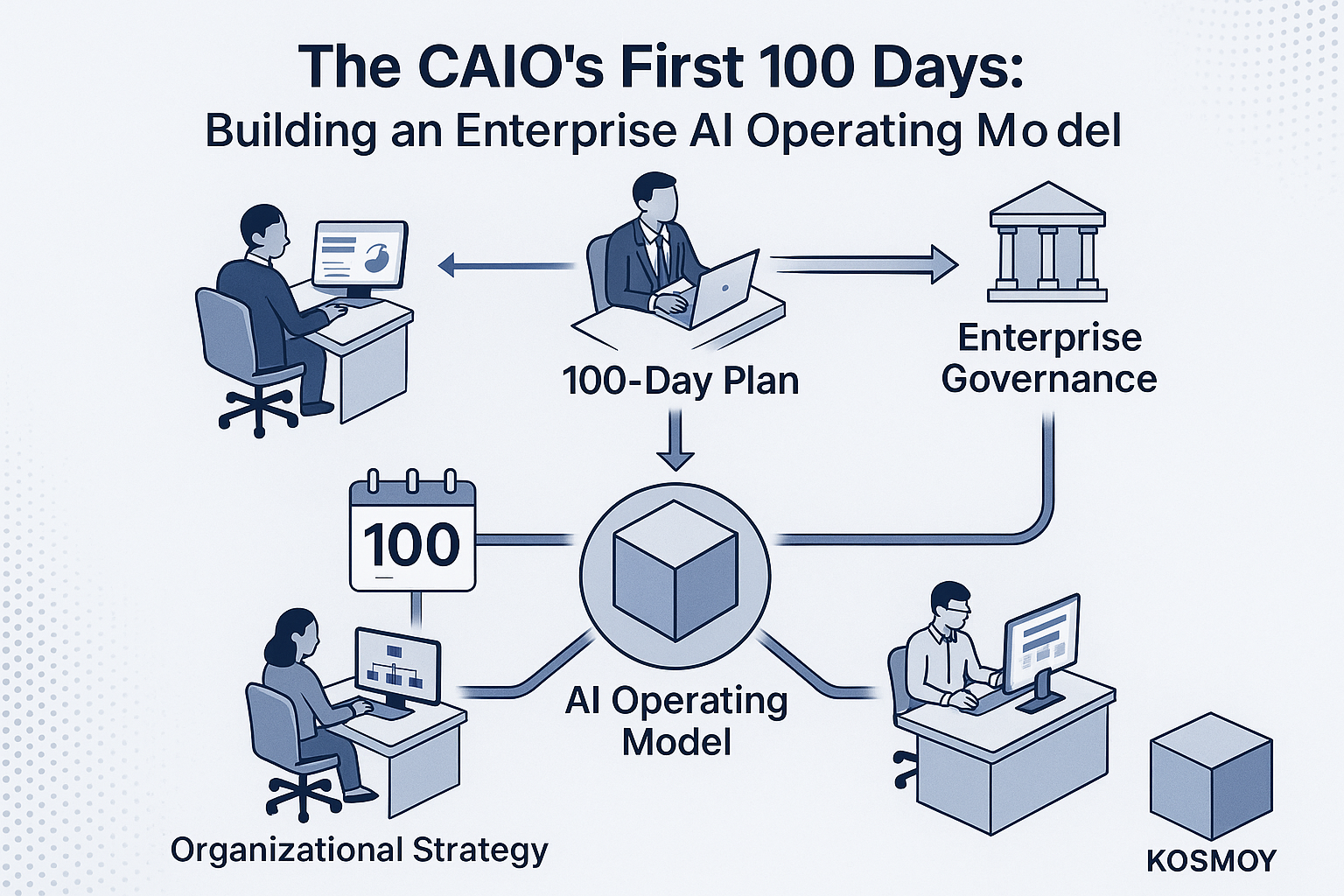

Congratulations — you're the new Chief AI Officer. Now what?
The CAIO title has appeared on more org charts in the last eighteen months than in the entire previous decade. And yet the role remains one of the most consequential and least defined positions in the C-suite. You are expected to drive innovation, manage risk, control costs, and satisfy regulators — all simultaneously, often without a clear mandate, a dedicated budget, or an inherited operating model to build on.
Most CAIOs inherit chaos: dozens of GenAI tools deployed by individual departments, overlapping vendor relationships, no centralized visibility into spend, and governance gaps that no one has had the authority — or the time — to close. The first 100 days are not about picking the right model or launching a flagship use case. They are about building the foundation that makes every subsequent decision faster, safer, and more defensible.
Here is the framework.
Why the First 100 Days Define the CAIO's Trajectory
First 100-day frameworks exist for a reason: they force prioritization before the default agenda takes over. Without a deliberate plan, a new CAIO spends the first quarter reacting — approvals backlogged, vendor pitches scheduled wall-to-wall, and urgent departmental requests that each individually seem reasonable but collectively prevent any coherent strategy from forming.
The CAIOs who build durable programs do something different. They treat the first 100 days as three sequential phases, each with a distinct objective:
- Discover — understand what exists before you try to change it
- Design — build the governance and infrastructure architecture
- Deliver — deploy against priority use cases with the infrastructure in place
Each phase is load-bearing. Skipping Discover to jump straight to Deliver is how CAIOs end up with governance frameworks that don't reflect reality, and infrastructure that doesn't match what the organization is actually doing.
Days 1–30: Discover
The most dangerous assumption a new CAIO can make is that they know what GenAI is being used in their organization. They don't — not yet. Shadow AI is pervasive. The official procurement register captures a fraction of actual usage. The rest is distributed across individual SaaS subscriptions, API keys stored in developer laptops, and departmental tools approved by line managers with no IT visibility.
The Discover phase has three objectives.
Map every GenAI application in use — including unofficial ones
This is not an audit. It is an intelligence-gathering exercise. Your goal is a complete picture of the GenAI landscape: every application, every API integration, every internally-built tool, and every third-party service that touches an LLM. Unofficial usage is often the most valuable signal — it tells you where the organization's GenAI demand is strongest and where governance gaps are largest.
Practical starting points: cross-reference software expense reports with known AI vendor names, survey IT helpdesk tickets for GenAI-related requests, and interview department heads with a non-punitive framing. You are mapping, not policing.
Identify who owns what, and where governance gaps exist
Ownership matters because governance without owners doesn't hold. For each GenAI application you discover, identify: who approved it, who maintains it, which data it accesses, and what the escalation path is if something goes wrong. Where no one can answer those questions, you have found a governance gap. Document every gap. This list becomes the input to Days 31–60.
Assess current spend and vendor relationships
GenAI spend is typically fragmented, duplicated, and underreported. Consolidate: token consumption by team and application, contract terms and renewal dates, overlapping capabilities across vendors, and total cost attribution per business unit. This baseline is the starting point for the cost visibility infrastructure you will build in the Design phase.
By Day 30, you should have a complete (or near-complete) inventory of your GenAI estate: what exists, who owns it, where the gaps are, and what it costs. Most CAIOs are surprised by the size of what they find.
Days 31–60: Design
Discovery gives you the map. Design gives you the architecture. The Design phase is about making deliberate structural choices — governance framework, technology infrastructure, and cost management — before you scale anything.
The Design phase has three objectives.
Define your AI governance framework
Governance is not a policy document. A policy document tells people what they should do. Governance is the system of controls, roles, and accountability mechanisms that determines what actually happens — including when no one is watching.
A functional AI governance framework for an enterprise covers:
- Guardrails — what content policies apply to LLM inputs and outputs, how they are enforced, and at what layer (application, gateway, or model)
- Access controls — who can deploy GenAI tools, what approval process is required, and how permissions are provisioned and revoked
- Compliance rules — which regulatory frameworks apply (EU AI Act, DORA, GDPR, sector-specific requirements) and how compliance is demonstrated at each AI touchpoint
- Risk classification — a tiered framework that distinguishes low-risk internal tools from high-risk agents with production system access, so controls are proportional
Design the framework before you deploy the infrastructure. The infrastructure should implement the framework — not the other way around.
Select a centralized platform that supports multi-LLM, multi-department deployment
The CAIO's job is not to pick the best LLM. It is to build the platform that lets every department use the right LLM for their use case — safely, consistently, and without each team reinventing governance from scratch.
The architectural requirement is a centralized AI Gateway: a layer through which all LLM traffic passes, regardless of which team built the application, which vendor the model comes from, or whether the deployment was IT-approved or business-led. The gateway is where governance policies are enforced uniformly — authentication, content policy, audit logging, cost attribution — without requiring every development team to implement them independently.
Key capabilities to evaluate:
- Multi-LLM routing — the ability to route traffic to different model providers based on cost, capability, latency, or compliance requirements
- Policy enforcement — content guardrails, PII screening, and compliance rules applied at the gateway layer, not inside individual applications
- Observability — real-time dashboards for usage, cost, latency, and error rates across all departments and applications
- No-code agent builder — a governed environment where business users can build GenAI workflows without creating shadow AI
Establish cost visibility and tracking
GenAI cost management is an infrastructure problem, not a finance problem. Without token-level attribution by team, application, and use case, cost optimization is guesswork. The Design phase is when you put the metering infrastructure in place.
Cost visibility serves two purposes: it enables optimization (identifying waste, rightsizing model selection, consolidating duplicated capabilities), and it enables accountability (business units can see what they are spending and why). Both require the same underlying data — attribution at the request level.
Days 61–100: Deliver
Discovery gives you the map. Design gives you the architecture. Delivery proves both work.
The Deliver phase is not about deploying AI broadly. It is about deploying AI in 2–3 priority departments with the infrastructure you just built — generating early evidence that the operating model works, surfacing the gaps the design didn't anticipate, and creating organizational momentum.
The Deliver phase has three objectives.
Deploy governed AI infrastructure across 2–3 priority departments
Choose departments that combine high GenAI demand (from the Discovery inventory) with manageable risk profiles and willing executive sponsors. These are not necessarily the highest-visibility use cases — they are the ones where a successful deployment can be cited as a model for the rest of the organization.
Deploy the full stack: the AI Gateway in the critical path for all LLM traffic, policy enforcement active, cost attribution running, audit logging on. This is not a pilot of a specific use case. It is a live proof that the operating model functions in production.
Launch a no-code agent builder to accelerate business-led innovation
The fastest path to GenAI ROI in most enterprises is not engineering-built applications. It is business users building their own GenAI workflows — the Finance analyst who automates contract review, the HR team that builds a governed onboarding assistant, the customer success manager who creates an agent that summarizes support tickets before every renewal call.
No-code agent builders make this possible without creating shadow AI, provided the agents run on the same governed infrastructure as everything else. Every no-code agent routes through the AI Gateway. Every interaction is logged. Every agent is registered in the central inventory. Business users get speed; the organization gets control.
Set up continuous monitoring dashboards for cost, usage, and quality
The operating model is not complete until it is observable. By Day 100, your organization should have live dashboards that answer, without manual investigation:
- What is our total GenAI spend this month, broken down by department and application?
- Which LLM calls are failing or producing low-quality outputs?
- Are any agents behaving anomalously — unexpected call patterns, policy violations, unusual token consumption?
- Which use cases are delivering measurable business value, and which are underperforming?
Monitoring is not a nice-to-have. It is the feedback loop that lets the operating model improve over time and the audit evidence that regulators expect.
The CAIO Mandate: Operating Model Over Model Selection
Here is the insight that separates the CAIOs who build lasting programs from those who spend three years switching between models chasing the next benchmark:
The CAIO who succeeds isn't the one who picks the best model. It's the one who builds the operating model that lets the entire organization use AI safely and effectively.
Model selection is a tactical decision. It changes every six months as new capabilities are released. The operating model — the governance framework, the centralized infrastructure, the accountability structures, the observability systems — is the durable asset. It is what survives model transitions, regulatory changes, and organizational restructuring.
The first 100 days are the window to build that foundation before the default agenda takes over. Discover what exists. Design the architecture. Deliver against priority use cases with the infrastructure in place.
Your first 100 days set the trajectory. Make them count.
Frequently Asked Questions
What does a Chief AI Officer do? A Chief AI Officer (CAIO) is responsible for developing and executing an organization's AI strategy — including governance, infrastructure, cost management, and regulatory compliance. Unlike a Chief Data Officer or Chief Technology Officer, the CAIO's mandate spans across functions, vendors, and use cases, with a specific focus on ensuring AI is deployed safely and effectively at scale.
What is an enterprise AI operating model? An enterprise AI operating model is the set of governance frameworks, infrastructure decisions, accountability structures, and operational processes that determine how an organization deploys and manages AI. It answers: who can use AI, under what conditions, governed by which controls, at what cost, and with what oversight. An operating model is distinct from any specific AI application or model — it is the system that governs all of them.
Why do the first 100 days matter for a CAIO? The first 100 days establish the foundation before the default agenda takes over. CAIOs who spend this period mapping the existing AI estate, designing governance infrastructure, and delivering early proof points create durable programs. CAIOs who skip to deployment without this foundation often spend years managing the consequences — ungoverned usage, cost overruns, compliance gaps, and governance frameworks that don't reflect how AI is actually being used.
What is shadow AI, and why does it matter for a new CAIO? Shadow AI refers to GenAI tools and applications deployed within an organization without formal IT approval or governance oversight — individual SaaS subscriptions, developer API keys, departmental tools approved by line managers. Shadow AI is typically far more prevalent than official procurement records indicate. For a new CAIO, mapping shadow AI is the first governance priority, because you cannot govern what you cannot see.
What is an AI Gateway, and why do CAIOs need one? An AI Gateway is a centralized layer through which all LLM traffic passes, regardless of which application, department, or model provider is involved. It enforces authentication, content policies, compliance rules, and audit logging uniformly — without requiring every development team to implement governance independently. For a CAIO building an enterprise AI operating model, the AI Gateway is the foundational infrastructure piece that makes multi-LLM, multi-department deployment governable.
How do you govern no-code GenAI agents in an enterprise? No-code GenAI agents should be governed through the same infrastructure as everything else: all LLM calls route through the central AI Gateway, every agent is registered in a central inventory, and high-risk agents (those with production system write access) run in sandboxed execution environments. The governance model enables business-led innovation without creating shadow AI — business users build freely; the platform ensures every agent operates within policy.
What are the key GenAI regulations a CAIO needs to understand? The EU AI Act classifies AI systems by risk level and imposes documentation, testing, human oversight, and audit logging requirements for high-risk applications. DORA (Digital Operational Resilience Act) requires financial institutions to manage ICT risks including AI systems. GDPR applies to any AI processing personal data. Sector-specific frameworks (HIPAA for healthcare, FINRA for financial services) add additional requirements. A CAIO's governance framework should be designed to satisfy all applicable frameworks through shared infrastructure — not parallel compliance programs.
What should a CAIO prioritize in the first 30 days? Discovery: mapping every GenAI application in use (including unofficial deployments), identifying ownership and governance gaps, and establishing a baseline of current spend and vendor relationships. Most CAIOs are surprised by the size and fragmentation of what they find. The Discovery output is the input to every subsequent governance and infrastructure decision.