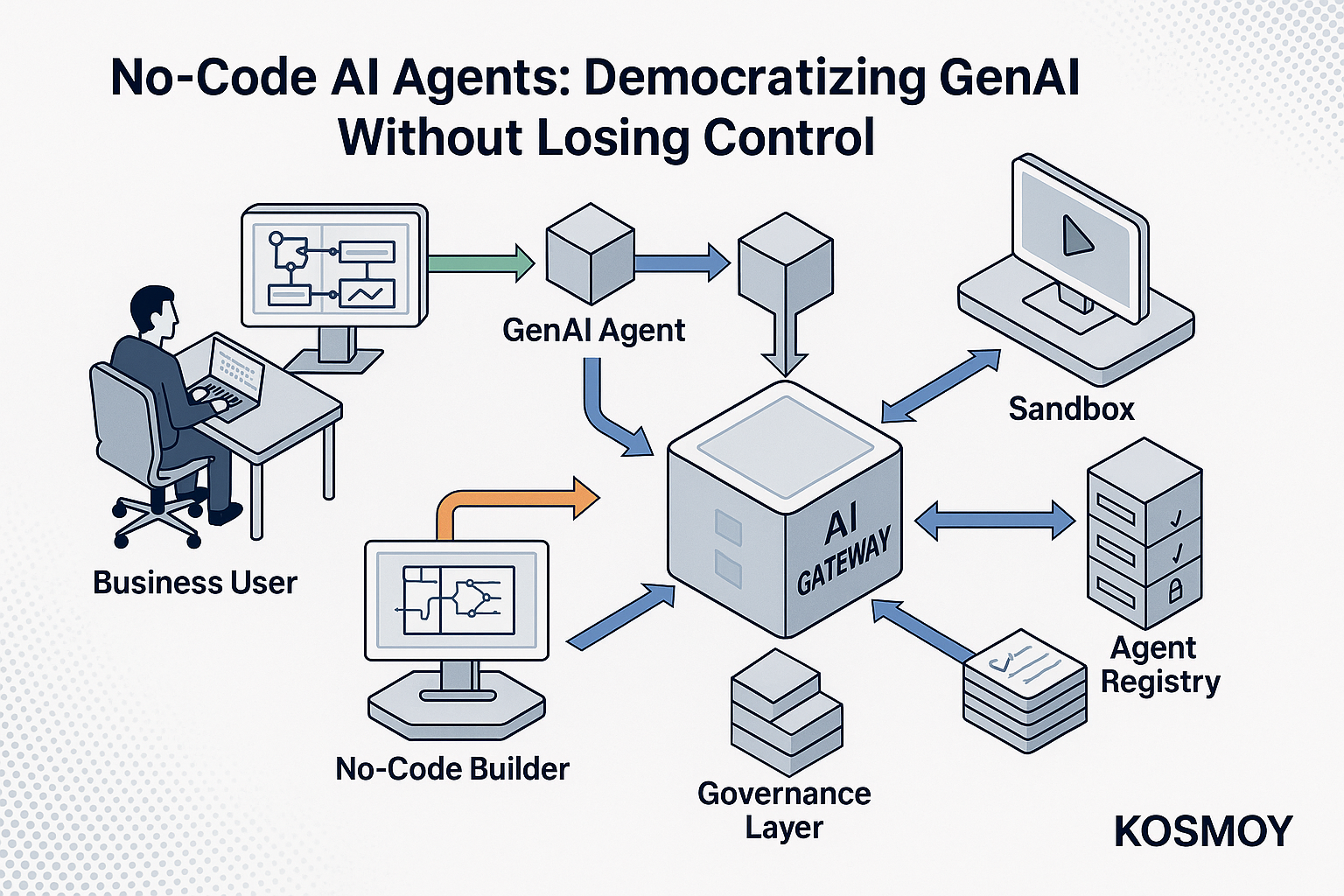

The fastest-growing GenAI trend inside enterprises right now is not a new foundation model. It is the spreadsheet analyst in Finance who built a GenAI agent last Tuesday — without writing a single line of code.
No-code AI agent platforms are proliferating fast. Tools like n8n, Zapier AI, Microsoft Copilot Studio, and vendor-specific agent builders let non-technical users compose, deploy, and run autonomous GenAI workflows in hours. For business velocity, this is extraordinary. For enterprise risk teams, it is a governance emergency in slow motion.
This article explains what no-code GenAI agents are, why they matter, and — critically — how enterprises can democratize GenAI without surrendering the control that regulated industries require.
What Is a No-Code AI Agent?
A no-code AI agent is an autonomous GenAI workflow built through a visual interface — drag-and-drop nodes, pre-built connectors, and natural-language configuration — that requires no programming expertise to deploy.
Unlike traditional chatbots or copilots that answer questions, no-code AI agents take actions: they read from and write to external systems, call APIs, send messages, trigger processes, and make decisions based on model outputs. The "no-code" qualifier refers to the builder's experience, not the agent's capability. These agents are fully capable of accessing production systems.
Key characteristics:
- Autonomous execution — the agent runs on a schedule or trigger, not on user command
- Multi-step reasoning — the agent chains LLM calls with tool use and conditional logic
- System integration — the agent connects to CRMs, ERPs, databases, communication tools, and external APIs
- Minimal IT involvement — deployment is controlled by the business unit, not engineering
Why No-Code GenAI Is Accelerating
Three forces are driving rapid adoption of no-code GenAI agents across enterprise functions.
1. The Productivity Gap Is Real
GenAI has proven its value in isolated tasks — summarization, drafting, classification. The next unlock is chaining those tasks into end-to-end workflows. Business users see the opportunity clearly: a GenAI agent that monitors incoming contracts, flags risk clauses, routes for review, and logs outcomes in the CRM replaces a process that previously required four people and five days. No-code platforms make that agent buildable in an afternoon.
2. IT Backlogs Are Creating Workarounds
Enterprise IT teams are overwhelmed with GenAI requests. Business units unwilling to wait six months for an approved implementation are building their own solutions. No-code platforms are the path of least resistance — and they are increasingly powerful enough to serve real production use cases.
3. Vendor Ecosystems Are Normalizing It
Every major software vendor — Microsoft, Salesforce, ServiceNow, HubSpot — now ships native AI agent builders targeted at non-technical users. GenAI is no longer a capability you add to software. It is embedded in the tools employees already use daily.
The Control Problem: Where No-Code GenAI Goes Wrong
Democratization without governance is not empowerment. It is shadow AI at scale.
When a business unit deploys a no-code GenAI agent without enterprise oversight, several categories of risk emerge simultaneously.
Data Exposure
No-code agents frequently connect to sensitive data sources. A GenAI agent built by a sales rep to summarize customer calls may, by default, send those transcripts to a third-party LLM provider with no data processing agreement in place. The user who built the agent has no visibility into the data flow. Neither does IT — until there is a breach.
Prompt Injection
No-code agents consume external inputs — emails, documents, web pages, form submissions — and pass them to LLMs. This creates prompt injection exposure: a malicious input can override the agent's instructions and redirect its actions. An agent with CRM write access that is prompt-injected can corrupt customer records or exfiltrate data. The builder of a no-code agent has no way to defend against this without infrastructure-level controls.
Ungoverned Model Access
No-code platforms make it trivial to connect to any LLM endpoint the builder has credentials for. This means different agents across the organization may be using different models, different providers, and different cost structures — with no central visibility into spend, performance, or compliance posture.
Accountability Gaps
When a no-code GenAI agent makes an error — misclassifies a customer, sends an incorrect communication, or writes bad data — tracing the cause requires execution logs, model version information, and input/output records. Without centralized observability, these investigations are impossible.
GenAI Democratization Done Right: The Governance Architecture
The answer is not to ban no-code GenAI agents. That approach fails — business units find workarounds, and the risk goes underground. The answer is to build a governance layer that enables democratization safely.
Enterprises that are getting this right share a common architectural pattern.
Centralized GenAI Gateway
All LLM calls — regardless of which no-code platform or agent made them — pass through a centralized AI Gateway. The gateway enforces authentication, applies content policies, logs every request and response, and routes traffic to approved model endpoints. Business units retain the freedom to build; the gateway ensures every inference is governed.
A GenAI gateway provides:
- Model governance — only approved providers and model versions are accessible
- Cost control — token usage is tracked and attributed by team and agent
- Audit trail — every LLM interaction is logged for compliance and investigation
- Policy enforcement — guardrails applied uniformly, regardless of the builder's expertise
Agent Sandboxing
No-code GenAI agents that interact with production systems should run inside a sandboxed execution environment. The sandbox enforces what the agent can and cannot do at the infrastructure level — not by asking the agent to cooperate, but through kernel-level controls and network egress restrictions.
This is the distinction between a guardrail (a soft boundary the agent can bypass) and a sandbox (a hard perimeter the agent cannot exit). For agents with write access to production systems, only the sandbox is an adequate control.
Centralized Agent Registry
Every GenAI agent deployed in the organization — including those built on no-code platforms — should be registered in a central inventory. The registry captures: who built it, what it does, what systems it accesses, which model it uses, when it last ran, and what its risk classification is.
Without a registry, the organization cannot answer the most basic governance question: "What GenAI agents are running right now, and what can they do?"
Usage and Drift Monitoring
GenAI agents built quickly by non-technical users are rarely optimized for stability. Models drift, prompts degrade, and integrations break. Continuous monitoring of agent behavior — tracking output quality, error rates, and anomalous patterns — is the early warning system that prevents silent failures from becoming business incidents.
What GenAI Democratization Should Look Like in Practice
A mature enterprise GenAI program treats no-code agents the way it treats any other business application: with appropriate controls proportional to risk.
Low-risk agents (internal summarization, personal productivity) — builder registers the agent, standard LLM gateway policies apply, basic logging.
Medium-risk agents (external communication, read access to production data) — additional policy review, data classification enforced at the gateway, output logging with retention.
High-risk agents (write access to production systems, customer-facing automation, regulated processes) — full sandboxing, kill switch, mission control supervision, mandatory audit trail.
The framework enables business units to move fast on low-risk use cases while applying proportional controls where the stakes are higher. GenAI democratization and enterprise governance are not in tension. They require the same infrastructure.
Frequently Asked Questions
What is a no-code AI agent? A no-code AI agent is an autonomous GenAI workflow configured through a visual interface — without writing code — that can execute multi-step tasks, call APIs, and interact with external systems. Examples include agents built in n8n, Microsoft Copilot Studio, or Zapier AI.
Is GenAI democratization safe for enterprise use? GenAI democratization is safe when paired with the right governance infrastructure: a centralized AI Gateway for all LLM calls, agent sandboxing for production system access, a centralized registry of deployed agents, and continuous monitoring. Without these controls, no-code GenAI is shadow AI at organizational scale.
What is the difference between a GenAI chatbot and a GenAI agent? A GenAI chatbot responds to user input with text. A GenAI agent takes autonomous action — it executes multi-step workflows, writes to systems of record, calls external APIs, and makes decisions without human intervention at each step. The risk profile is fundamentally different.
How do you govern no-code GenAI agents built by business users? The most effective governance model combines a centralized AI Gateway (all LLM calls pass through it regardless of source), an agent registry (every deployed agent is inventoried), sandboxed execution for high-risk agents, and usage monitoring. Business users retain the ability to build; the platform ensures every agent operates within policy.
What is prompt injection and why does it matter for no-code agents? Prompt injection is an attack where malicious content in an agent's input overrides its instructions, redirecting the agent's actions. No-code agents are particularly vulnerable because they often consume untrusted external data — emails, documents, web content — without input sanitization. Infrastructure-level controls, not prompt engineering, are the reliable defense.
What GenAI governance regulations apply to AI agents? The EU AI Act classifies AI systems by risk level and imposes requirements for high-risk applications including documentation, testing, human oversight, and audit logging. DORA (Digital Operational Resilience Act) requires financial institutions to manage ICT risks including AI systems. No-code GenAI agents accessing production financial or personal data are likely subject to both frameworks.
What is the first step to governing no-code GenAI agents in an enterprise? Start with an inventory. Before you can govern GenAI agents, you need to know what is running. A centralized agent registry — capturing every deployed agent, its capabilities, data access, and risk classification — is the prerequisite for every other governance action.