
Your hyperscaler can govern your AI, as long as the AI stays in its cloud. Azure AI Foundry, AWS Bedrock and Google Vertex AI ship a model registry, guardrails, evals, tracing, identity and billing for the models they host. Then the perimeter ends. An open-weight model you serve on your own hardware, an agent acting on internal systems, an MCP server reading internal data: none of them sits inside it. For that part of the estate, every control has to run where the models run.
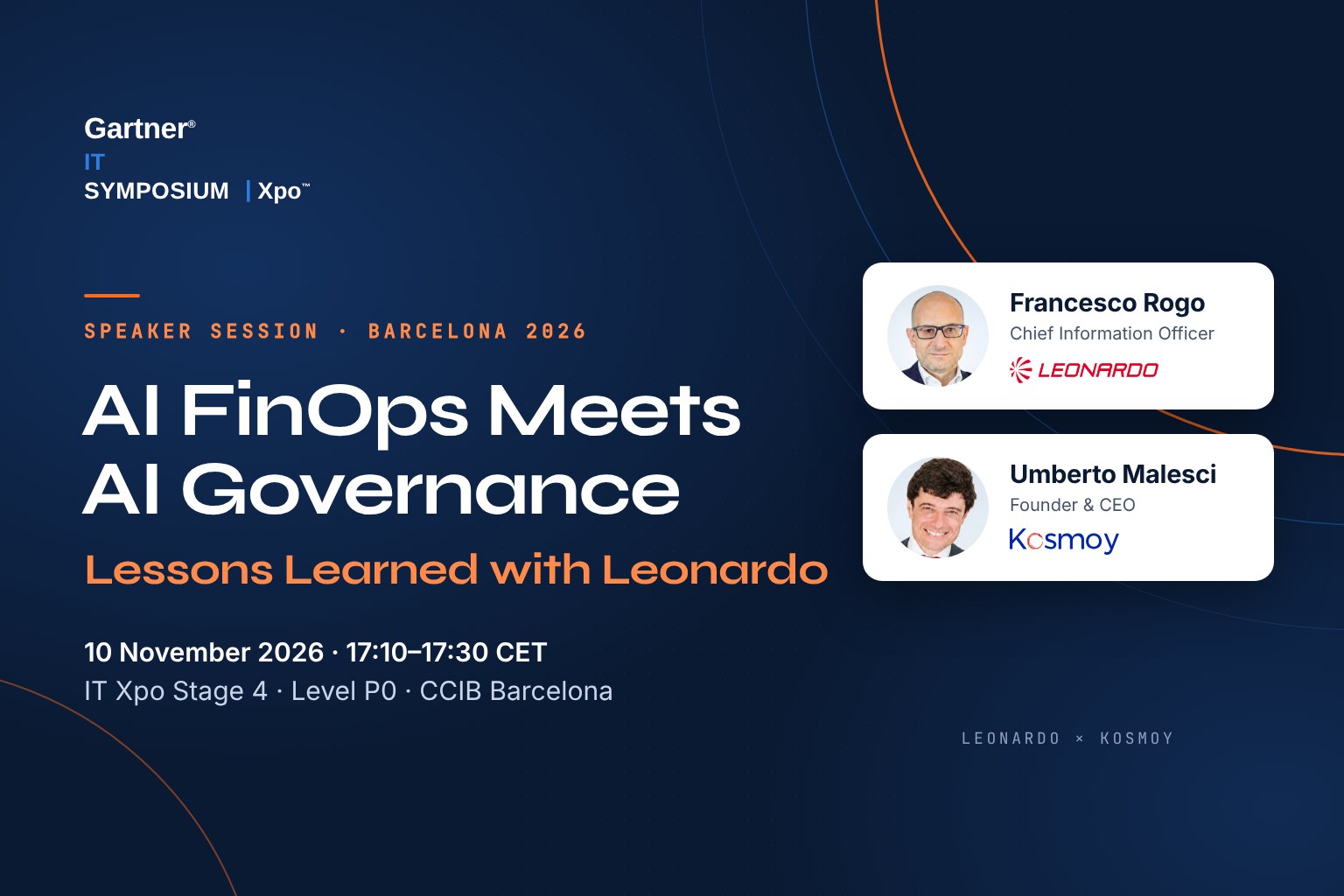
That is the subject of our session at Gartner IT Symposium/Xpo 2026 in Barcelona. AI FinOps Meets AI Governance: Lessons Learned with Leonardo runs on Tuesday 10 November 2026, 17:10–17:30 CET, on IT Xpo Stage 4, Level P0 of the CCIB. I share the stage with Francesco Rogo, Chief Information Officer of Leonardo.
Speaker session · Gartner IT Symposium/Xpo Barcelona
AI FinOps Meets AI GovernanceLessons Learned with Leonardo
Open-source LLMs at enterprise scale: controlling costs and meeting governance requirements without slowing adoption.

Francesco Rogo
Chief Information Officer


Umberto Malesci
Founder & CEO


- Date
- Tuesday 10 November 2026
- Time
- 17:10–17:30 CET
- Where
- IT Xpo Stage 4 · Level P0, CCIB, Barcelona
The money has the same perimeter
Inside a hyperscaler's studio, cost is a billing feature: calls are priced, metered and invoiced, usually by the token. Served on your own hardware, an open-weight model looks free. There is no per-token price. The cost is GPU capacity, shared by every team that calls the model.
Run both and the gap shows at once. A developer asks a cloud model one question and a self-hosted model the next, from the same coding tool. The cloud bill sees half. The infrastructure budget sees the other half, as hardware. Nobody sees the developer, the use case or the agent behind the calls.
That gap is where AI FinOps meets AI governance. Both need the same control point:
- To attribute the cost of a call, you need to know who made it, from which application, to which model. That is identity and inventory, the base of any governance programme.
- To cap spend, you need a policy enforced on the call itself. The same mechanism blocks an unapproved model, or a tool an agent should not touch.
- To prove either, you need a log of every call, with an owner. Finance reads it for cost. Audit reads it for compliance.
AI FinOps and AI governance are not two programmes that ought to coordinate. They run on the same machinery. Build them apart and developers face a second gate, a second key and a second review. Adoption slows and the workarounds start. Build them on one gateway and every call passes one checkpoint that meters it, checks it and records it. The full cost argument is in a meter and a switch on every AI workload.
What the 20 minutes will cover
Two speakers take on the question in the abstract: how to control the cost of open-source LLMs at enterprise scale and meet governance requirements without slowing adoption.
Part 1, the map (Umberto Malesci, Kosmoy). I will set out the 10 practices that separate AI pilots from AI at scale, from inventory and shadow AI to agent containment and deployment sovereignty. Then the 4 layers of control that apply them:
- Inventory. Every model, agent and MCP server is registered with an owner and a risk tier.
- Monitoring. Every call is measured. Every system is attacked before go-live.
- Governance. One gateway sits between every app and every model, tool and agent.
- Action control. AI that acts runs in a sandbox whose single exit is its own gateway.
The layers stack. A SaaS copilot may need nothing more than a registry entry; an open-weight model or an autonomous agent is contained outright. Part 1 closes with the AI lifecycle, from register and classify to observe and improve. Any change is re-tested before it goes back live. The control layer stays with the customer, not with any cloud or model vendor.
Part 2, the terrain (Francesco Rogo, Leonardo). Leonardo is Europe's largest defence and aerospace company, organised in divisions that include helicopters, aircraft, space, cyber security and electronics. It runs Kosmoy in its AI operating layer. His part is planned to cover what it takes to govern AI across an estate like that, and where the studios' built-in controls stop. It closes with lessons learned; those are his to share on stage. The session ends with audience questions.
One budget per developer, any model
One pattern on the agenda shows where money and rules meet. Coding tools are a hard test case: developers mix IDE plug-ins, CLI agents and chat, and each can call a different model, private or cloud. A budget per tool splits one developer's spend into pieces. A budget per model misses the developer who moves between them.
The pattern puts the budget on the person:
- At sign-in with company credentials, each developer gets a personal gateway and a personal API key with a monthly limit.
- Every call from any coding tool passes through that developer's gateway, where it is metered and logged.
- One limit covers self-hosted and cloud models.
- The owner is warned at 80% of budget. At 100%, calls are blocked.
The limit follows the developer, not the tool or the model. With the limit on the person, no one has to wait for the month-end invoice to see the spend, and no one has to drop a tool to stay inside it. The identity, gateway and log that enforce the budget are the same ones that answer the auditor.
Who should come
The session is for people who own AI in production:
- CIOs and CTOs who serve open-weight models on their own infrastructure, or plan to.
- Heads of platform engineering and FinOps asked to put a number, and a limit, on AI spend across private and cloud models.
- Chief AI Officers, CISOs and compliance owners who need evidence that a policy ran, not only that it was written.
- Teams in regulated sectors, from defence and aerospace to financial services and the public sector.
For the rest of the week, see our CIO AI control checklist and 12 AI governance questions for the expo floor.
How to attend and meet us
Add the session to your schedule from the Gartner agenda or the calendar button in the card above. Conference details are on the official site.
Kosmoy is also exhibiting. A 20-minute talk will not cover your estate; a meeting can. Book a meeting in Barcelona or email sales@kosmoy.com with the days you are on site. Bring the models you serve yourself, the agents that act on your systems and the bill nobody can attribute. We will map where each control would run.
FAQ
What is the Leonardo and Kosmoy session at Gartner IT Symposium/Xpo 2026?
AI FinOps Meets AI Governance: Lessons Learned with Leonardo is a 20-minute speaker session at the CCIB in Barcelona. It runs on Tuesday 10 November 2026, 17:10–17:30 CET, on IT Xpo Stage 4, Level P0. The speakers are Francesco Rogo, Chief Information Officer of Leonardo, and Umberto Malesci, Founder & CEO of Kosmoy. The abstract: "Open-source LLMs at enterprise scale: controlling costs and meeting governance requirements without slowing adoption."
Why do AI FinOps and AI governance belong together?
Both depend on the same control point. Attributing the cost of a call means knowing who made it, from which application, to which model: the same identity and inventory that governance needs. Capping spend means enforcing a policy on the call, the same mechanism that blocks an unapproved model. Run both on one gateway and every call passes one checkpoint that meters it, checks it and records it.
Do hyperscaler AI studios govern self-hosted open-weight models?
No. Azure AI Foundry, AWS Bedrock and Google Vertex AI ship controls such as a model registry, guardrails, evals, tracing, identity and billing for the models in their cloud. Open-weight models a company serves on its own infrastructure, agents acting on internal systems and MCP servers on internal data sit outside those controls. Controls for those systems have to run where the models run, on infrastructure the company controls.
Gartner and Gartner IT Symposium/Xpo are trademarks of Gartner, Inc. and/or its affiliates. Kosmoy is an exhibitor and speaker at the 2026 Barcelona conference. Gartner does not endorse Kosmoy or its products.