AI INVENTORY · MODEL REGISTRY
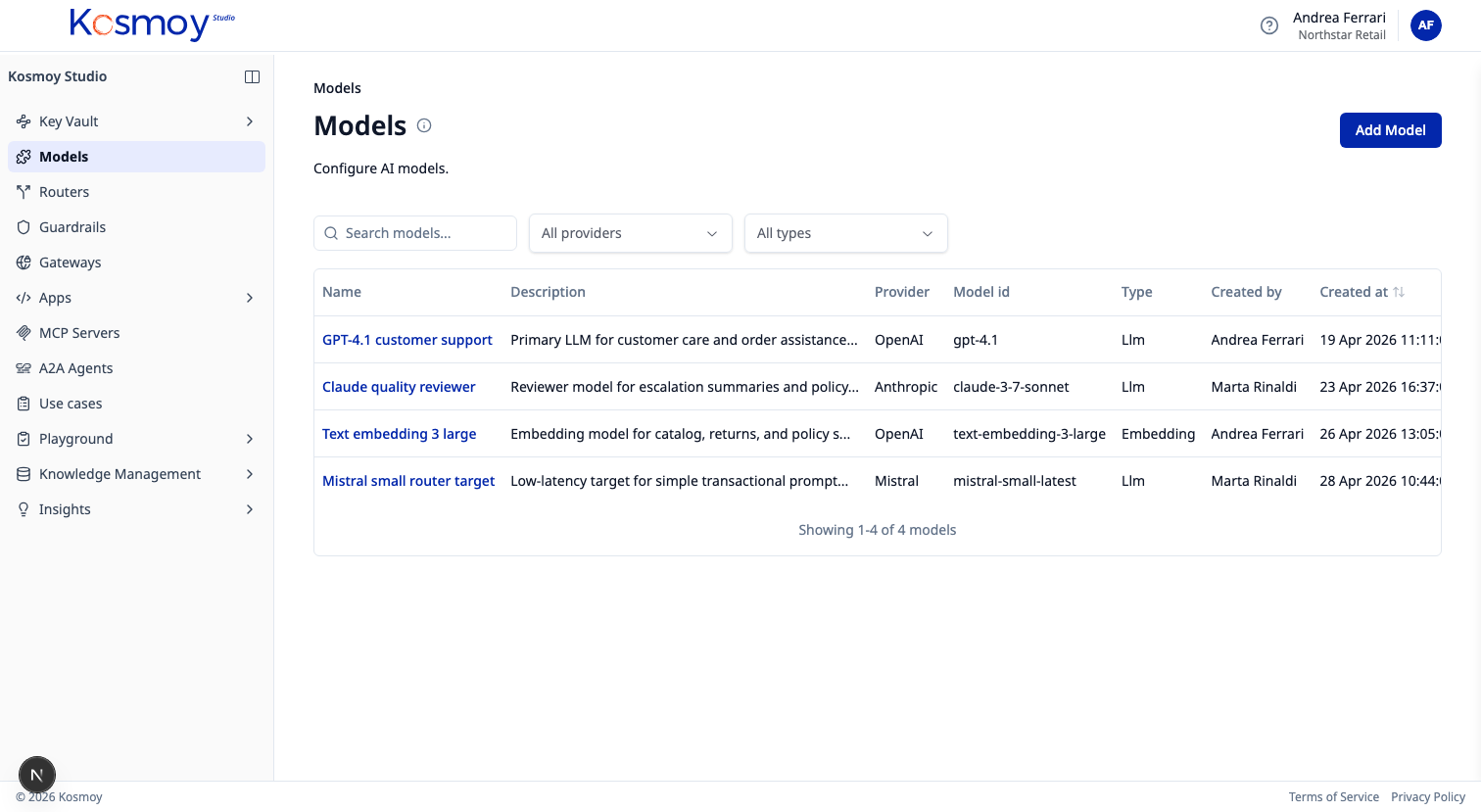
Every approved model, in one catalogue.
Public LLMs, private LLMs, embedding models, fine-tuned SLMs — provider, version, deployment mode, approval state, allowed use cases.
Or email sales@kosmoy.com.
The Model Registry is the source of truth for which models the central AI team has approved. Every entry connects to a provider, an approval state, a list of allowed use cases and an RBAC scope.
Switching from one model to another is a configuration change in the Gateway, not a code rewrite in every app.
What it does.
Provider-agnostic catalogue
OpenAI, Anthropic, Google, Mistral, Meta, Hugging Face, Azure, AWS, on-prem and SLMs.
Approval lifecycle
Draft → approved → deprecated → retired. Every transition logged.
Allowed use cases
Restrict each model to the use cases it's been approved for.
Version + deployment mode
Cloud-hosted, private, fine-tuned. The Gateway routes accordingly.
Cost metadata
Per-token pricing, latency, region — feeds the Insights dashboard.
Audit trail
Every approval, deprecation and access change is an event in the dossier.
Module questions, answered straight.
Which model providers are supported?
OpenAI, Anthropic, Google, Mistral, Meta, Hugging Face, Azure OpenAI, Azure AI Foundry, AWS Bedrock, on-prem deployments, and fine-tuned SLMs. New providers are added each release.
Can we register private and fine-tuned models?
Yes. Public LLMs, private LLMs, embedding models, fine-tuned SLMs — side by side, with the same approval state and access controls.
How is approval state managed?
Each model has a state — draft, approved, deprecated, retired — and a list of allowed use cases. RBAC determines which teams can call which models.
Enterprise proof
Built for environments where AI cannot become another unmanaged SaaS silo.
Kosmoy works with regulated and operationally critical organizations, including Banca d’Italia and Leonardo.


- Runs in your Kubernetes
- Azure · AWS · GCP · on-prem
- LLM · MCP · A2A
- No mandatory vendor-hosted control plane
See the Model Registry.
Walk through approval, lifecycle and per-use-case scoping.
Or email sales@kosmoy.com.