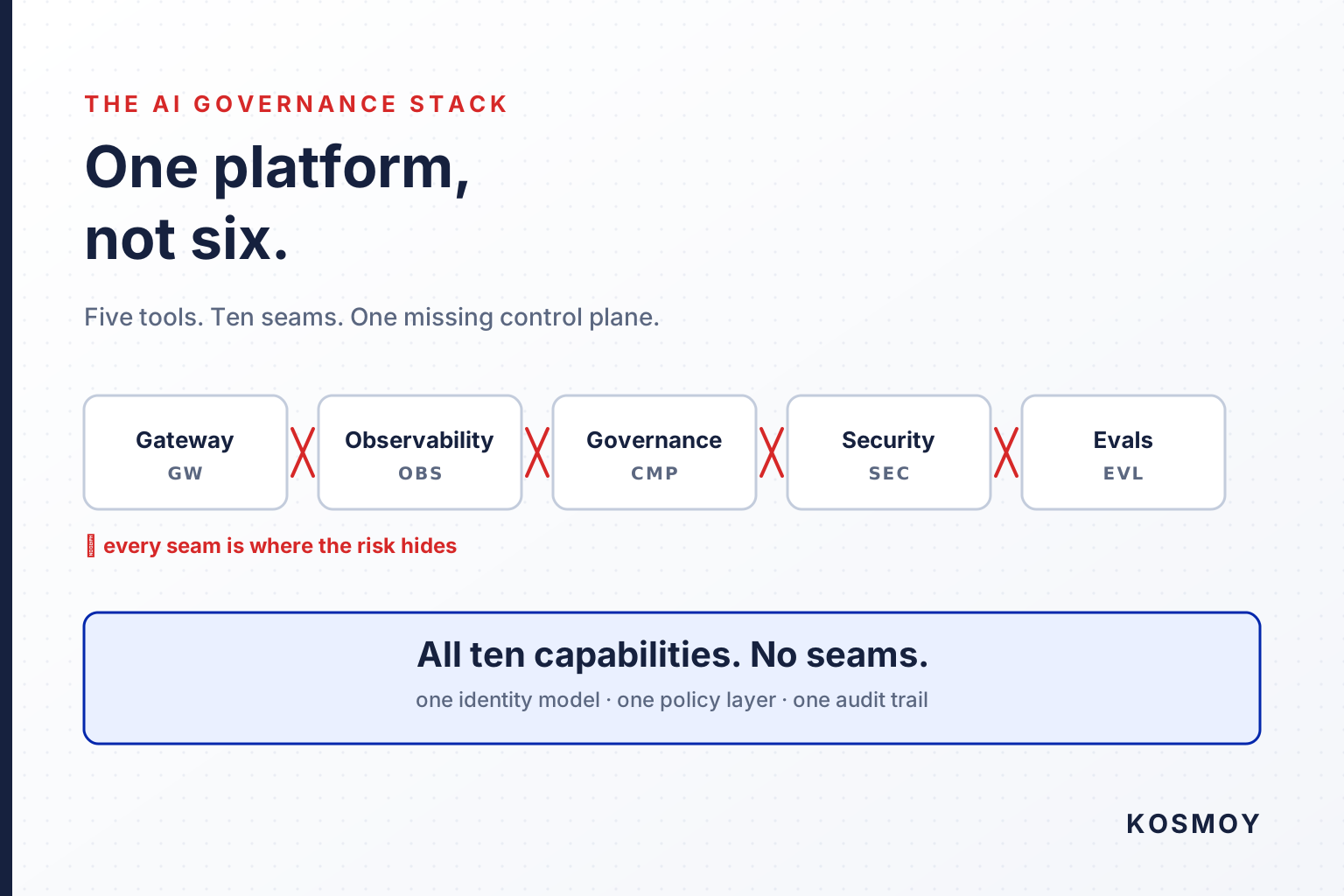

Walk into any enterprise that takes AI seriously in 2026 and ask to see the governance stack. You will usually find a list that looks like this: an AI gateway for traffic, an observability platform for cost and quality, a governance suite for documentation, a security scanner for threats, and an eval tool the data science team runs before launches.
Five products. Five contracts. Five identity models. Five sets of logs.
Each of those tools is good at what it does. That is precisely the problem: each one is good at a slice of the job, and nobody owns the whole.
Ten capabilities, sold two or three at a time
Running AI at enterprise scale takes ten capabilities. You need to know what you run (inventory and discovery), catch what you didn't sanction (security and shadow AI), watch cost and quality (observability and FinOps), put policy in the path (gateway), block harmful calls (guardrails), contain what acts autonomously (agent containment), prove it all to an auditor (compliance), test before and after launch (evals and red-teaming), build governed agents (agent building), and do all of it in infrastructure you control (deployment sovereignty).
We plotted the tools market against those ten axes on the AI capability map. The pattern is consistent: every emerging product category covers two or three spokes and leaves the rest to someone else.
An AI gateway is one policy point — and thin everywhere else. An observability platform watches everything — and enforces nothing. A governance suite documents the estate — and never touches the runtime. A security platform finds and blocks threats — and doesn't run the lifecycle. Eval tools test before launch — and are absent in production.
None of this is a criticism of those products. It is what a category is: a slice.
The seams are the risk
The uncomfortable truth about the five-tool stack is not the license cost, although procurement will notice that too. It is the seams.
The gateway logs a call; the observability platform traces it; the governance suite has never heard of it. An agent gets flagged by the security scanner; the eval tool tested a different version three weeks ago; nobody updated the risk register. A red-team finding lives in a PDF while the guardrail that should encode it lives in another vendor's console.
Every pair of point tools produces a seam, and a five-tool stack has ten of them. Seams are where the unregistered agent hides, where the policy that exists on paper fails to exist at runtime, and where the audit trail fragments into four consoles the week the regulator asks for it.
There is also a quieter cost: reconciliation. Someone in your platform team is spending their week gluing five tools together — syncing identities, correlating logs, exporting evidence — and that glue is now itself an unowned, untested system in your AI estate.
What "consolidate" actually means
Consolidating AI governance does not mean a big-bang migration, and it should not mean discarding tools that are genuinely deep on their spoke.
It means three moves, in order.
First, put one policy point in the path. An OpenAI-compatible gateway that every app, model and MCP server routes through gives you the place where policy is enforced rather than described. Existing tools can keep reading from it.
Second, claim the spokes nobody sells. Two capabilities on the map have no specialist category at all: agent containment and deployment sovereignty. No point tool ships a kernel-enforced sandbox with scoped credentials and a kill switch, and no SaaS control plane can make itself sovereign. If your stack is five tools and none of them can contain an agent or run air-gapped, the stack is not finished — it is unfinishable.
Third, retire overlaps at renewal. When the platform's observability, evals and compliance evidence cover what the point tools covered, each renewal becomes a decision point instead of an automatic line item. Most teams we work with retire the stack over two or three renewal cycles, not in one quarter.
The objection: "our tools are better on their spoke"
Sometimes true — and the map says so. Pure-play eval platforms still lead on experiment tracking and annotation workflows. Dedicated agent builders go deeper than a governed builder. The honest version of the consolidation argument is not that one platform beats every specialist on every axis. It is that the marginal depth of a specialist on its spoke is rarely worth the seam it creates with everything else — and that five specialist slices still leave the map's hardest spokes empty.
That trade is an empirical question, which is why we publish vendor-by-vendor comparisons scored on the same ten axes, with citations, including the spokes where specialists beat us.
One loop, one audit trail
The end state of consolidation is not a shorter vendor list. It is an operating model: every AI system registered and classified, assessed, evaluated, deployed behind the right control, guarded at one gateway, observed against budget — one loop, run by one platform, leaving one audit trail as a by-product.
That is the case against the AI governance stack. Not that the tools are bad, but that governance assembled from slices governs the slices — and your risk lives in the whole.
Frequently asked questions
How many tools does an AI governance stack need?
Assembled from point categories, five or six: a gateway for traffic, an observability platform for cost and quality, a governance suite for documentation, a security scanner and an eval tool. That still leaves agent containment and deployment sovereignty uncovered, because no specialist category sells them.
Should you consolidate AI governance tools?
Consolidate the policy path first, then claim the spokes nobody sells, then retire overlaps at renewal. The argument is not that one platform beats every specialist on its own axis — it is that the seams between five specialists are where unregistered agents, unenforced policies and split audit trails live.
What is the risk of using separate AI governance tools?
Every pair of tools creates a seam. A five-tool stack has ten of them: the agent the gateway never saw, the policy the observability tool cannot enforce, the red-team finding that never became a guardrail, and an audit trail spread across four consoles the week a regulator asks.