Provider neutrality
Public APIs, hyperscaler services and private models through one stable client contract without locking policy to one vendor.
ENTERPRISE LLM GATEWAY · SELF-HOSTED · MULTI-PROVIDER
Give every application one OpenAI-compatible endpoint while the enterprise controls identity, approved models, regional routing, guardrails, budgets and evidence — inside its own Kubernetes.
Or email sales@kosmoy.com.
An enterprise LLM gateway removes model-provider decisions and credentials from individual applications. Teams call one endpoint. The platform team decides which providers, models, regions and private endpoints are available to each workload and environment.
Kosmoy applies the same authentication, RBAC, prompt and response guardrails, routing, fallback, budgets and logging to every call. Public APIs, cloud model services and private models can coexist behind one policy boundary without creating a different integration and audit trail for each provider.
Because the gateway runs in the customer’s Kubernetes, prompts, responses, logs and credentials do not need to transit a vendor-hosted control plane. That deployment model is designed for regulated enterprises, sovereign workloads and teams that need private connectivity rather than another public SaaS hop.
Existing clients generally change one base URL while provider credentials and selection move out of the application.
OpenAI, Anthropic, Google, Mistral, Azure, Bedrock, vLLM, Ollama and fine-tuned SLMs behind one route.
Users, teams, applications and agents receive explicit access to approved models, routes and environments.
PII, prompt injection, toxic content and custom policy checks run before prompts leave and before responses return.
Optimise cost and quality, fail over across providers, and enforce spend limits by app, team, model or use case.
Model choice, latency, tokens, cost, policy events and outcomes remain attributable to the calling workload.
Enterprise buying criteria
A proxy can normalise APIs. An enterprise gateway must also become a dependable security, policy and evidence boundary for dozens of teams and production applications.
Public APIs, hyperscaler services and private models through one stable client contract without locking policy to one vendor.
Every application and agent is authenticated and authorised independently rather than sharing a provider key.
A control plane and request path that can run in the enterprise cloud, region, network or on-premises cluster.
Prompt and response controls, tool and model allowlists, redaction and approval rules applied consistently.
Routing, retries, fallback, quotas and failure isolation that keep applications available when a provider is not.
Tokens, latency, price, policy events and model outcomes allocated to the exact app, agent, team and use case.
The LLM gateway is the model-facing part of a broader AI gateway. The same policy boundary can extend to MCP tools and A2A agent traffic as enterprise use cases become more autonomous.
Commercial clarity
Commercial scope reflects deployment, support and the gateway capabilities required. Model-provider usage remains visible separately, so the enterprise can distinguish platform cost from inference cost.
The main sizing factors
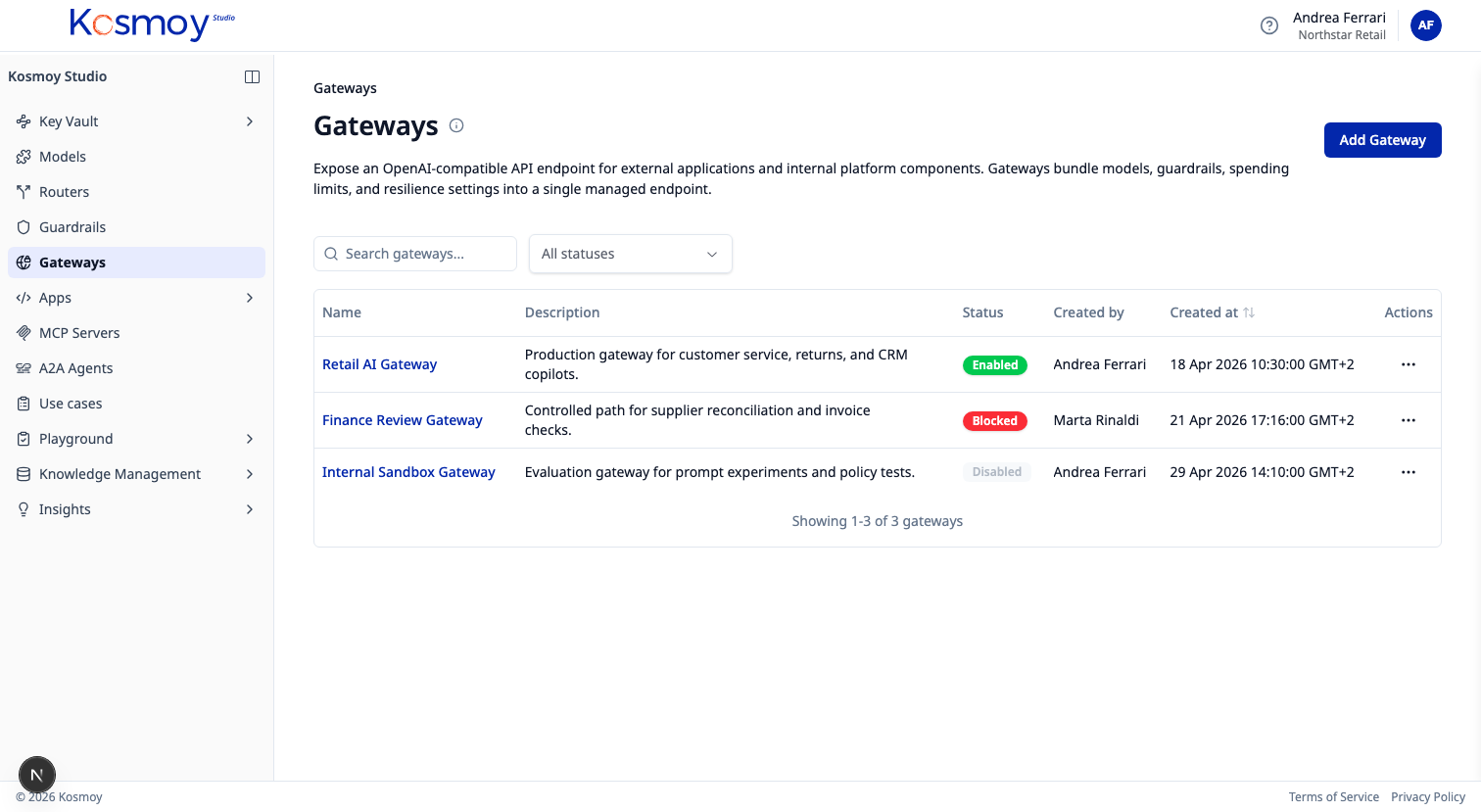
An enterprise LLM gateway is the policy boundary between applications and model providers. Apps call one endpoint; the gateway authenticates the caller, checks which models it may use, applies prompt and response guardrails, routes or fails over, records cost and latency, and keeps an attributable audit trail.
Yes. It runs single-tenant in your Kubernetes on Azure, AWS, GCP or on-premises, including isolated environments. Prompts, responses, logs and provider credentials remain inside the deployment boundary you control; there is no mandatory vendor-hosted control plane in the request path.
The gateway can keep its control plane, logs, credentials and policy processing inside an EU or on-premises environment selected by the customer. It can route only to approved regional endpoints or private models. Whether a complete workload meets a specific residency obligation also depends on the selected model endpoint and surrounding data systems.
OpenAI, Anthropic, Google, Mistral, Meta, Hugging Face, Azure OpenAI, Azure AI Foundry, AWS Bedrock, on-premises deployments through vLLM or Ollama, and fine-tuned small language models can sit behind the same OpenAI-compatible endpoint.
Most OpenAI-compatible clients change only their base URL. LangChain, LangGraph, LlamaIndex, custom Python or Java services and products with Bring-Your-Own-Model support can call Kosmoy while the enterprise keeps provider credentials and policy out of the application.
Financial institutions need a consistent identity boundary, approved-model list, regional routing, prompt and response controls, cost attribution and an audit record across many teams. A self-hosted gateway centralises those controls without forcing every application to embed provider credentials or rebuild the same compliance plumbing.
Enterprise proof
Kosmoy works with regulated and operationally critical organizations, including Banca d’Italia and Leonardo.


Bring a real application and provider mix. We will walk through identity, regional and private routing, guardrails, budgets, failover and audit evidence.
Or email sales@kosmoy.com.